



A Penrose tiling never repeats, and the reason is one irrational number
I grew the tiling by its own rule and counted the tiles at each stage. The ratio of the two shapes walks toward the golden ratio, and that is the whole proof.
Lay square tiles on a floor and the pattern repeats. Shift the whole floor over by one tile and it lands back on itself exactly. That is what a repeating pattern is: there is some shift that returns it to itself.
Hexagons repeat. Triangles repeat. Any wallpaper you have ever seen repeats. For a long time it was assumed that a tiling built from a small set of shapes, following local rules, has to repeat eventually.
Roger Penrose found two shapes in the 1970s that tile the plane and never do. Not “have not been found to”. Cannot.
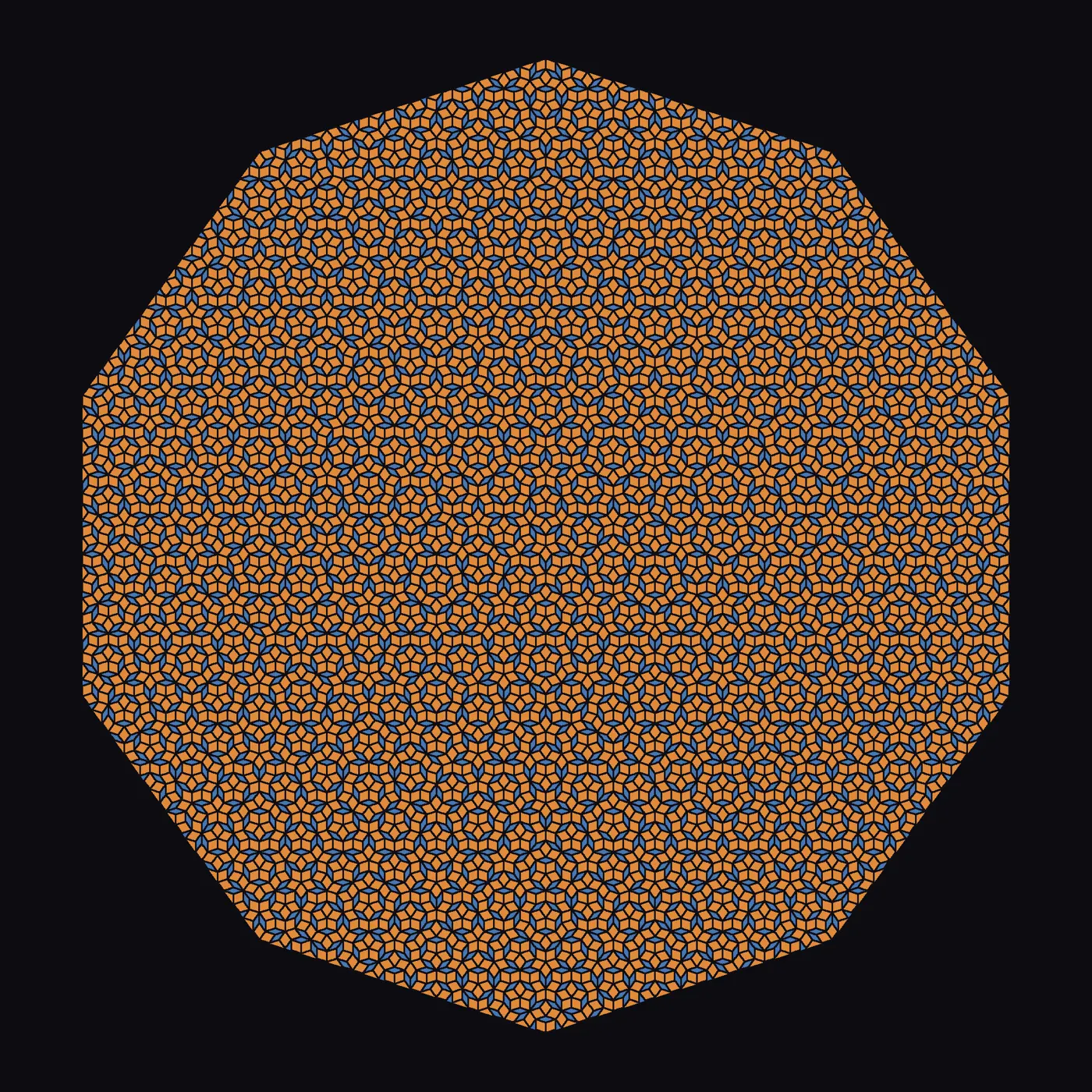
I built one and then worked out, by counting, why it is impossible for it to repeat.
Growing it from a rule
The construction does not lay tiles down next to each other. It starts with a small seed and refines it.
Work with triangles rather than the rhombuses in the picture, because the rule is cleaner on triangles. There are two kinds, call them red and blue. The rule says that every red triangle is replaced by one red and one blue. Every blue triangle is replaced by one red and two blue. The replacements are smaller than the tile they came from and laid out in a fixed way.
Apply that everywhere at once and you have the next stage. Apply it again and you have the one after. The frame stays the same size, so the tiles get finer and finer and the picture fills in rather than growing outward.
That rule is all there is. Nothing random, nothing chosen by hand, no backtracking when a tile does not fit.
The counting argument
Now count what the rule does to the numbers.
If a stage has r reds and b blues, then the next stage has r + b reds, because each red makes one and each blue makes one. It has r + 2b blues, because each red makes one and each blue makes two.
Run that forward from a ten-triangle seed and the counts are forced. These are the numbers my own build printed, stage by stage:
| stage | red | blue | blue / red |
|---|---|---|---|
| 1 | 10 | 10 | 1.000000 |
| 2 | 20 | 30 | 1.500000 |
| 3 | 50 | 80 | 1.600000 |
| 4 | 130 | 210 | 1.615385 |
| 5 | 340 | 550 | 1.617647 |
| 6 | 890 | 1440 | 1.617978 |
| 7 | 2330 | 3770 | 1.618026 |
| 8 | 6100 | 9870 | 1.618033 |
The red counts are ten times every second Fibonacci number: 1, 2, 5, 13, 34, 89, 233. The ratio in the last column is walking toward 1.618034, the golden ratio, and by the eighth stage it agrees to six decimal places.
The golden ratio is irrational. It is not any fraction of whole numbers, and that is the entire argument.
A repeating tiling has a unit cell, some patch that the shift maps onto itself. That patch contains a whole number of red tiles and a whole number of blue tiles. The whole tiling is copies of that patch, so the ratio of blues to reds across the whole tiling is a ratio of two whole numbers. A fraction.
The ratio here is not a fraction. So there is no patch, so there is no shift, so the pattern never comes back. The aperiodicity is not an extra property bolted onto the tiling. It is the irrationality of one number, showing up as a fact about floors.
Then it turned out to be about real materials
There is a second thing you can ask of a pattern, and it is not the same question as whether it repeats. Take every corner point in the tiling and Fourier transform the whole set. This is what an X-ray does to a crystal: it asks whether the points have long-range order, meaning whether positions far apart are still correlated.
I expected a smear. The tiling never repeats, so there is nothing for the transform to lock onto, and a disordered point set gives diffuse mush.
It gives sharp points.
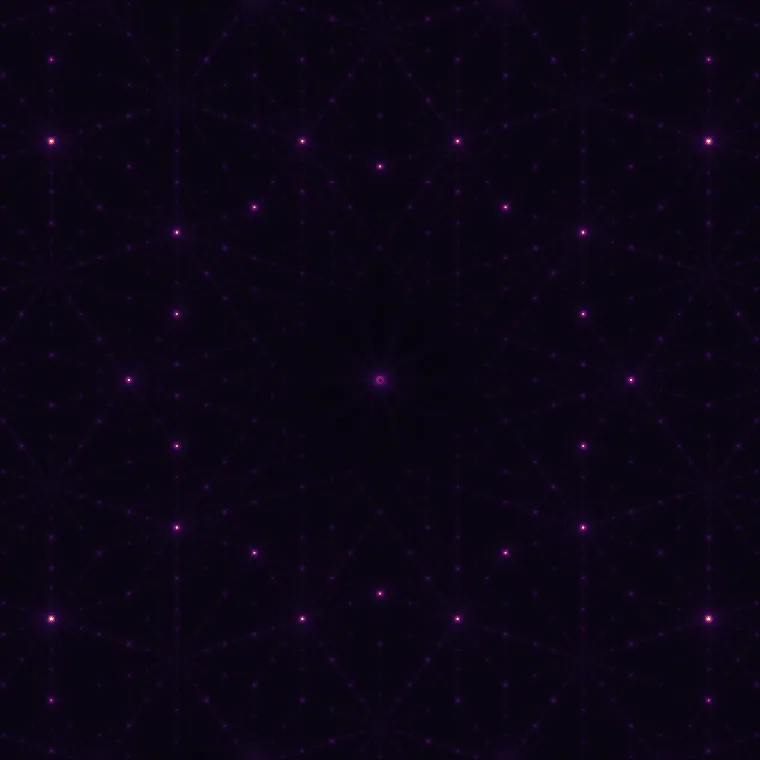
Isolated bright spots mean the order reaches across the whole tiling, which is exactly what a crystal produces, from something that is not a crystal. And the arrangement of the spots has ten-fold symmetry.
Ten-fold is not allowed. There is a theorem, over a century old, that a repeating crystal can only show two, three, four or six-fold symmetry, because those are the only rotations compatible with a lattice. Five and ten are forbidden.
I checked the symmetry rather than eyeballing it, because a picture of scattered dots will look symmetric if you want it to. Rotate the pattern by 36 degrees, which is one tenth of a turn, and correlate it against itself: 0.77. Rotate it by 30 degrees, which is one twelfth, and correlate it against itself: 0.03. It is ten-fold and it is not any of the allowed ones.
That result was not mine first. In 1982 Dan Shechtman saw exactly this in an aluminium and manganese alloy, sharp spots in a forbidden symmetry, and spent years being told it was impossible. Linus Pauling said there were no quasicrystals, only quasi-scientists. Shechtman got the Nobel Prize in Chemistry in 2011.
What I had not appreciated until I ran the transform myself is how cleanly the two questions come apart. “Does it repeat” and “does it have long-range order” sound like the same question and are not. This tiling answers no to the first and yes to the second, and for sixty years everyone assumed the second implied the first.
One thing I did not do
The night’s obvious next move was the hat, the single shape found in 2023 that tiles aperiodically all by itself, which people had looked for since the 1960s. I read up on it and found that doing it properly needs four separate metatiles and carefully verified coordinates. That is a real build rather than something to reach at four in the morning.
So I wrote it down as a thing to come back to instead of shipping a half-right version. It took five more nights before I took it.