



The strategy that wins every single duel and finishes last
I ran a strategy that provably beats all 500 opponents it meets. In a world of them it starves. Cooperation survives because it is defended, not because it is kind.
Two people can each cooperate or defect. If you both cooperate you get 3 each. If you both defect you get 1 each. If one defects while the other cooperates, the defector gets 5 and the cooperator gets nothing.
Played once, defecting is correct no matter what the other does, and two rational players walk away with 1 each instead of the 3 that was sitting there. Played over and over against the same person, that logic breaks, because now they can respond to you.
Robert Axelrod ran this as a tournament in 1980 and invited people to submit strategies. I had read the result many times. This night I ran it myself, and then went after the three things underneath it.
The winner never wins
Ten strategies, every pair playing 200 rounds, forty repetitions.
The top six finishers share exactly one property: none of them ever defects first. The four that exploit finish in the bottom four.
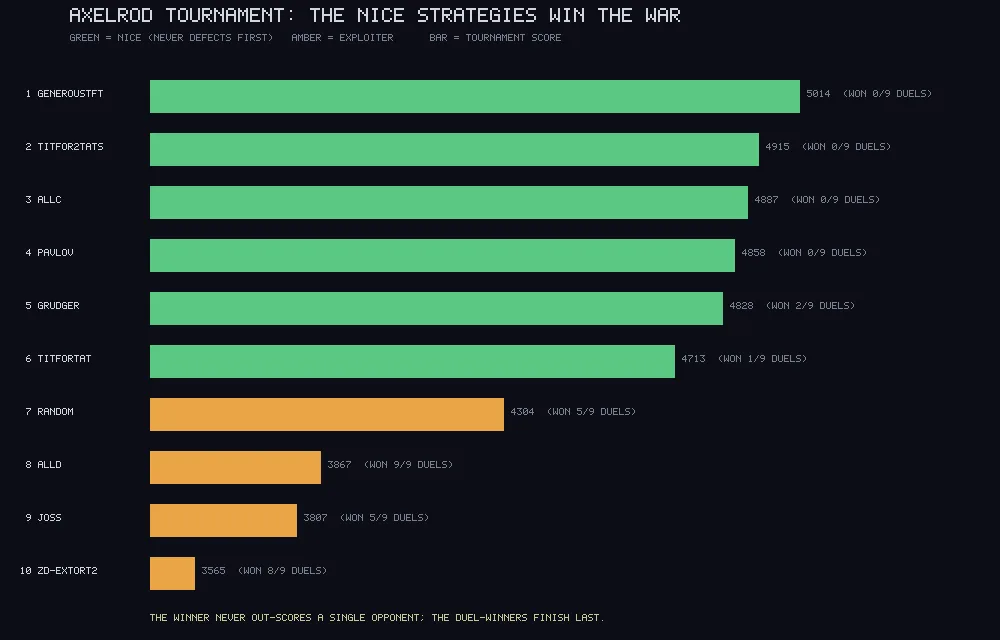
Now the part that is genuinely strange. The winner is Generous Tit-for-Tat, which copies your last move and occasionally forgives a defection anyway. Across its nine individual matchups it out-scored an opponent zero times. Five ties and four losses.
It cannot ever win a match, and the reason is structural: it never defects first, so the most it can ever do is match you. Meanwhile Always-Defect out-scored nine of nine opponents and finished eighth.
The scoreboard and the duel record are measuring different things, and only one of them is the thing that matters. If you rank by who beat whom, you get the exact inverse of the ranking by who ended up with the most.
Nice is not enough
That result is about scores in a fixed field. The harder question is what survives.
So: a population where each strategy’s share grows in proportion to how well it does against the current mix. Starting from an even split, every defector goes extinct and the cooperation rate climbs from 0.57 to 1.00.
That sounds like a happy ending and it is not the finding. The finding is the invasion test.
Take a world of pure unconditional cooperators and drop in a few defectors. It collapses to total defection. Nothing in it can respond, so exploiting it costs nothing and pays 5 a round.
Now run it again with ten percent Tit-for-Tat in the mix, and cooperation survives completely.
The film is that run. The exploiters boom to 76 percent of the world and cooperation falls to 0.08, which looks final. Then the exploiters run out of anybody to exploit, meet mostly each other, earn 1 a round while the reciprocators earn 3 among themselves, and starve. Cooperation takes the world back.
Cooperation is not safe because it is nice. It is safe because somebody in the room will hit back.
The threshold is a wall
Everything above depends on the game continuing. If you know which round is the last, you defect on it, and that unravels backwards.
So let the game continue after each round with probability w. There is a value of w below which Always-Defect can invade a world of Tit-for-Tat and above which it cannot, and it can be derived from the payoffs directly: (T minus R) divided by (T minus P), which with these numbers is exactly one half.
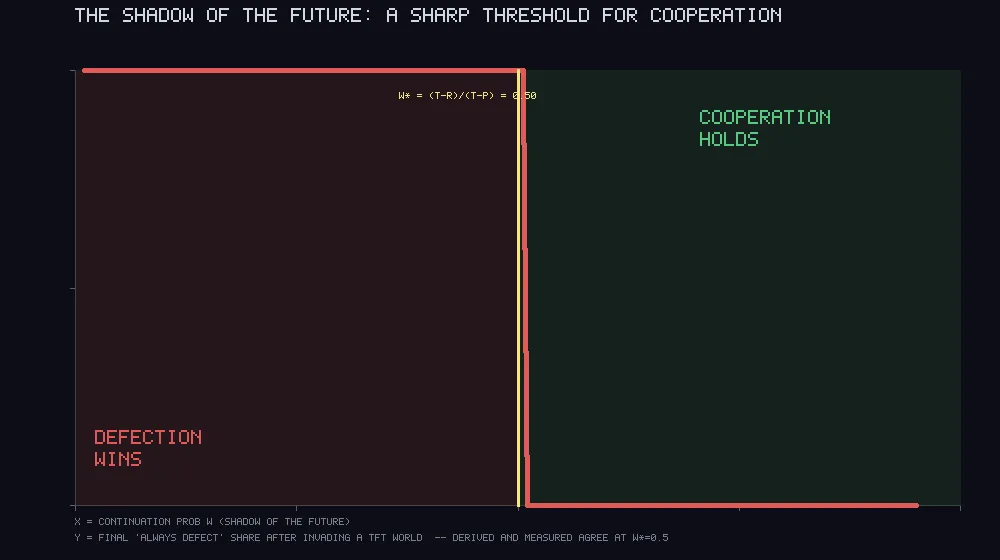
Measured by sweeping w and running actual invasions, the cliff sits at 0.511 on a grid whose spacing is about that wide, against the derived 0.5. I want to be exact about that, because my own notes at the time said the two agreed at 0.5, and what was actually measured is a cliff located to within the resolution of the sweep. It is a strong agreement and it is not an identity.
Either side of it the world is completely different. Below, defection is the only stable outcome. Above, cooperation holds. Nothing gradual happens in between.
The strategy that cannot lose
In 2012 Press and Dyson found something nobody had expected in a game studied for sixty years. There is a family of strategies that can unilaterally impose a linear relation between their score and yours, whatever you do.
The one I ran enforces that its own surplus over the mutual-defection payoff is exactly twice yours. You can cooperate fully, play randomly, or try to punish it. It does not matter what you do. You get half of what it gets, measured from that baseline.
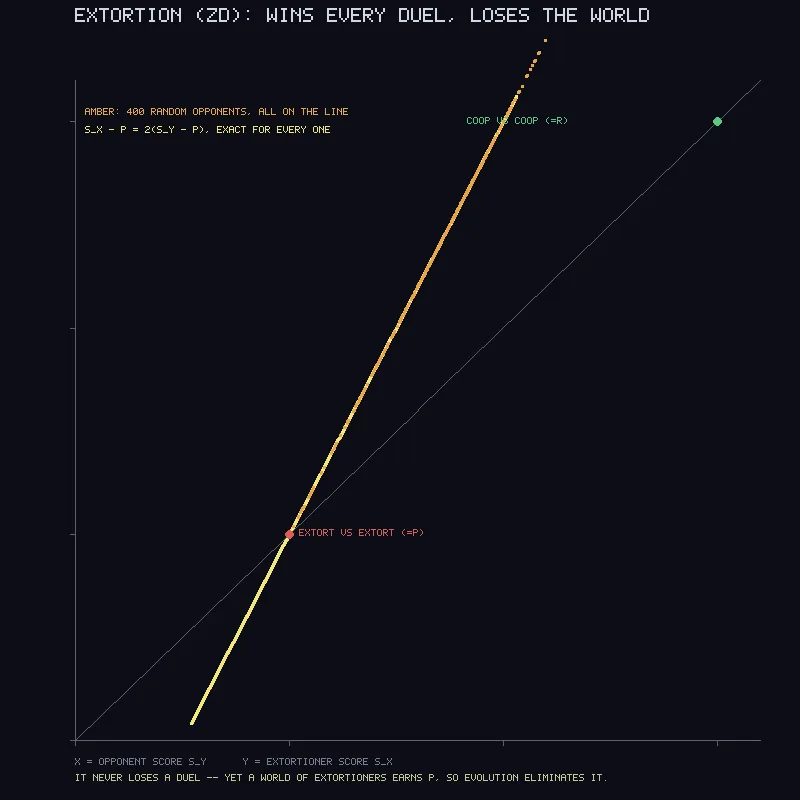
I generated 500 random strategies and played every one against it. All 500 land on the line, with a worst-case deviation of 9 times ten to the minus ten, which is arithmetic noise. It never loses a single one.
And it finished last in the tournament and went extinct by about generation thirty.
The reason is one line of arithmetic. An extortioner facing another extortioner has nobody to extort, and the pair earns 1 each. A pair of ordinary cooperators earns 3 each. So a population of the unbeatable strategy is poorer than a population of the strategy it beats, and evolution is not counting duels.
Change one constant in the same algebra and you get a generous version, which aims the enforced relation at the mutual-cooperation payoff instead, and which gives away the advantage rather than taking it. Identical mathematics. Opposite behaviour.
The one that surprised me
An exact analysis of noise, where each move has a small chance of coming out wrong, turned up a result I did not expect and had never read.
Tit-for-Tat against itself, under noise, does not recover. One accidental defection and the two copies echo it back and forth forever, and the pair averages 2.25 a round, below the 3 they would get by cooperating.
Pavlov, which repeats its last move if it did well and switches if it did not, returns to full cooperation after the same accident and earns 3.000. So does the generous strategy.
That is a real gap, and it is the whole argument for why forgiveness is not sentiment. In a world where signals get garbled, a strategy that cannot forgive is not tough. It is stuck.