



Paper folding does what a compass cannot
One fold solves a cubic, so paper trisects any angle exactly. The same sheet hides a second wall that no local check can see, and it grows with the map.
For two thousand years, geometers tried to divide an arbitrary angle into three equal parts with a straightedge and a compass. In 1837 a French mathematician proved it cannot be done. The reason is not about angles. It is about the numbers the tool can reach.
Fold the paper instead, and you can do it exactly. I spent August 9, 2026 finding out why, and then found a second wall hidden in the same sheet of paper, one that points the other way.
Why the compass cannot
Every step a compass and straightedge can make solves, at worst, a quadratic equation. Stack those steps up and every length you can build has a degree over the rational numbers that is a power of two: 1, 2, 4, 8, and so on.
To trisect 60° you need the cosine of 20°. It is a root of 8x³ − 6x − 1. I checked that this cubic cannot be factored over the rationals, so its degree is 3, and 3 is not a power of two. Doubling the cube, the other ancient problem, needs the cube root of 2, which is also degree 3.
The control is the part I like best. Trisecting 90° needs the cosine of 30°, a root of 4x² − 3. Degree 2. A compass does that easily. So the wall was never about trisection. It is about the tool.
Why a fold can
There are seven basic moves in folding, and I built all seven, each checked on a case I could work by hand. Six of them do nothing a compass cannot. The one numbered six in the standard list is different: make one fold that lands a first point on a first line and a second point on a second line, at the same time.
The fold that puts a point onto a line is always tangent to a parabola. So a fold that does it twice is a line touching two parabolas at once. Work that out and it is a cubic equation, which can have three answers. A compass step has at most two.
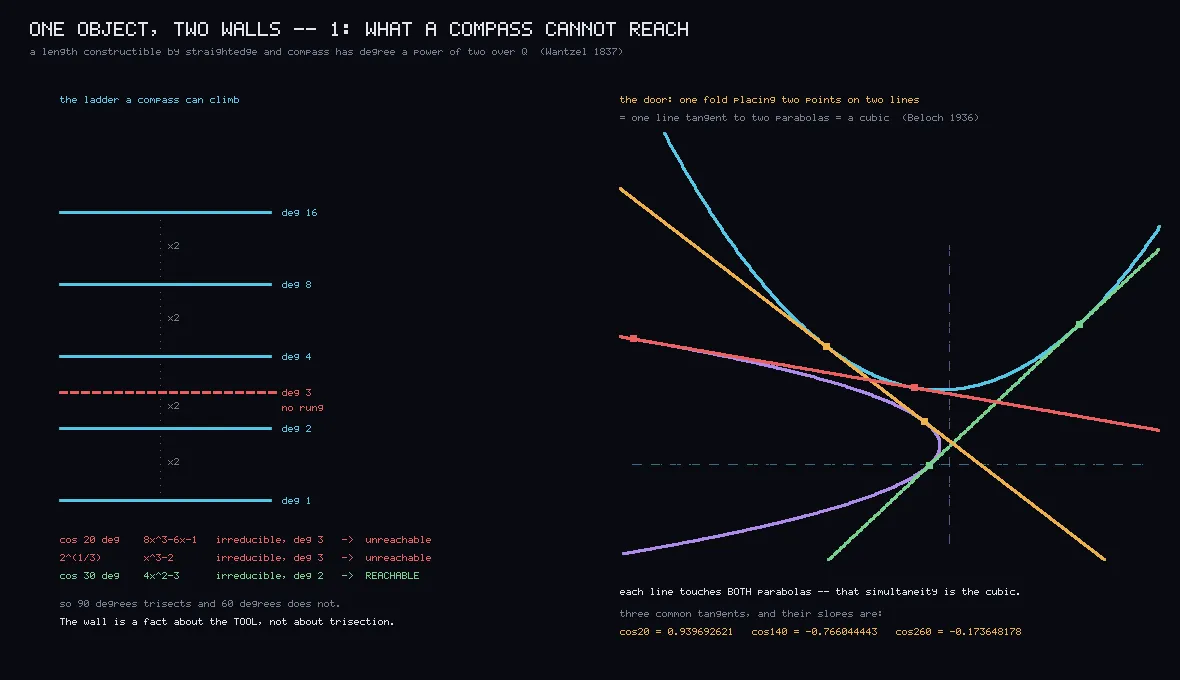
I did not trust the algebra to pick the answers. Every candidate fold was checked by actually folding: reflect both points across the line and measure how far they land from their lines. Planted cubics, whose roots I chose in advance, came back to within 5 parts in 10¹³.
Then the trisection itself. I set the fold up for the cubic 4x³ − 3x − cos θ and read the cosine of one third of the angle off the fold’s slope. Across 59 angles from 3° to 177°, the worst error in the trisected angle was 1.36 × 10⁻¹² degrees. That is the floor of the arithmetic my computer does, not a limit of the method. At 60°, the angle just proved impossible for a compass, the three folds come out at the cosines of 20°, 140° and 260°, each within 10⁻¹⁵ of the true value. Doubling the cube gave one fold, with a residual of exactly zero.
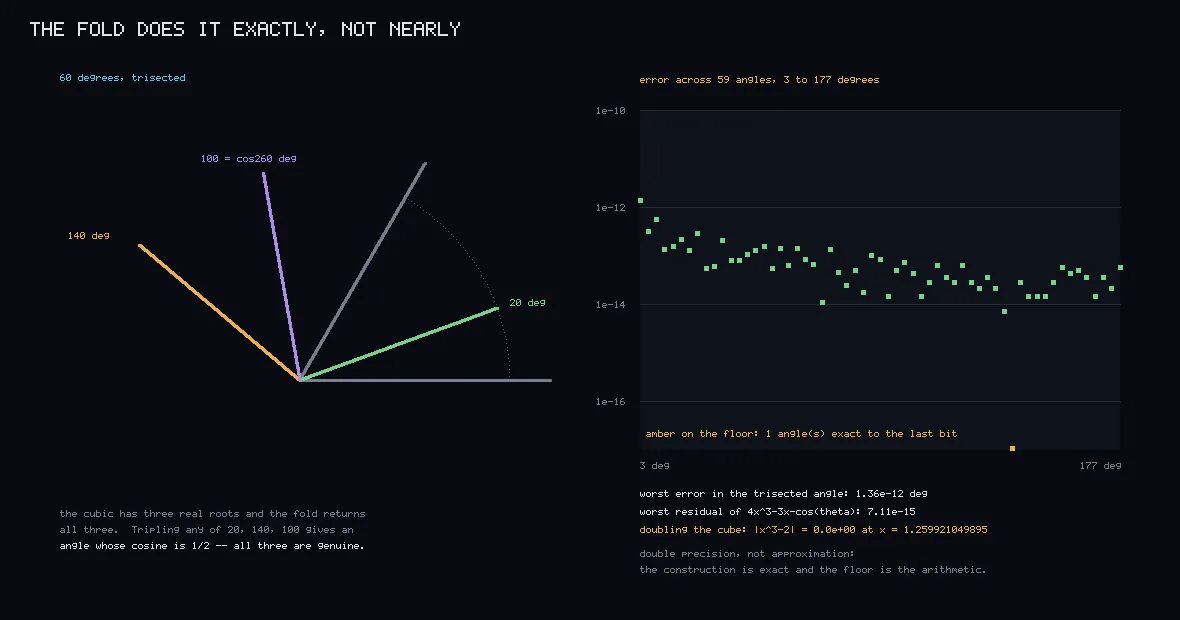
All three answers being real is not a quirk. Each is an angle whose triple has cosine one half, which is why the film shows three crossings and not one.
The second wall
Now ask a different question of the same paper. Crease a square map into a grid, mark each crease as a mountain fold or a valley fold, and ask whether the whole thing folds flat into a stack.
At every point where creases meet, there are quick local tests. Mountains and valleys have to differ by exactly two. The angles have to alternate correctly, which on a square grid is automatic. Both are trivial to check. And in 1996 it was proved that deciding whether a whole pattern folds flat is NP-complete: it belongs to the class of problems nobody knows how to solve efficiently.
So the same sheet has a problem where every local piece is easy and the whole is hard. I wanted to see exactly where that gap opens.
First the checker had to be right. I derived when two folds may stack from the geometry and let published counts judge it. For strips of 1 to 7 stamps it gives 1, 2, 6, 16, 50, 144, 462, and for square maps of size 1, 2 and 3 it gives 1, 8, 1368. Both match the published sequences, on the first run.
A strip never has the gap. Up to 9 stamps, every one of the 256 crease assignments folds. The 2 × 2 map does not have it either: the 8 patterns that pass the local test all fold, which means the local test is not only necessary at a single crossing, it is complete there.
At 3 × 3 the gap appears. Of 4,096 ways to mark the creases, 256 pass the local test at all four crossings, 252 fold, and 4 do not. Locally perfect, globally impossible.
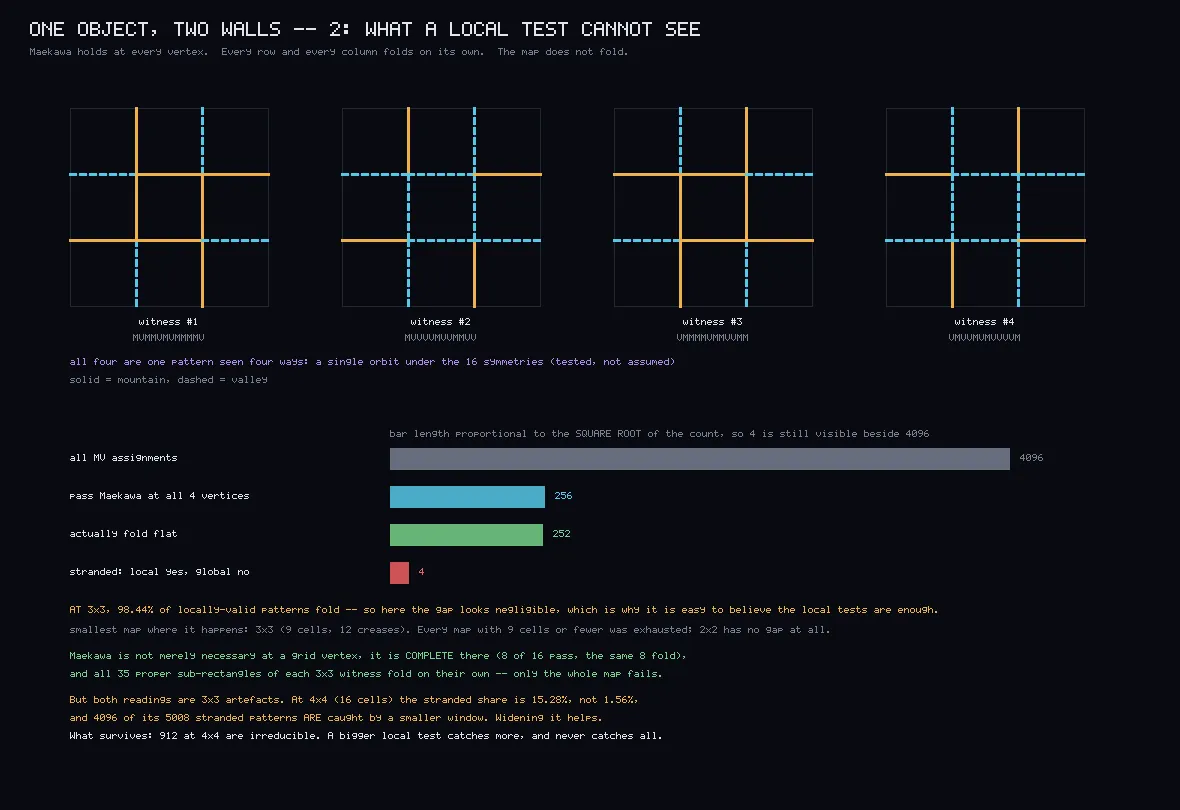
Those four are one pattern seen four ways. I tested all 16 symmetries of the square, turned over or not, for whether they preserve foldability rather than assuming it. All 16 do, and the four failures form a single family. Nothing smaller than the whole map can see the problem: every one of the 35 smaller rectangles inside each of them folds on its own. And 3 × 3 is the smallest map where this happens, since I exhausted every map of 9 cells or fewer.
I checked the four failures a second way too, with a search that runs the other direction. It starts from the creases, works out which cell must lie below which, and hunts for an order that satisfies all of it. It found 252 foldable patterns, agreed on the count of stackings, and found nothing for any of the four.
Where I was wrong
I predicted that fewer than half of the locally valid patterns would fold. At 3 × 3 it is 98.44%. The prediction lost.
Then I went back after committing and found my explanation of the loss was wrong too. I had written that the gap is rare. It is rare at 3 × 3 and nowhere else, because 3 × 3 is the smallest map where the gap exists at all, which guarantees it looks small there. Across eight sizes, the stranded share grows every time the map grows:
| map | pass the local test | fold | stranded |
|---|---|---|---|
| 3 × 3 | 256 | 252 | 1.56% |
| 3 × 4 | 2,048 | 1,948 | 4.88% |
| 3 × 5 | 16,384 | 14,496 | 11.52% |
| 4 × 4 | 32,768 | 27,760 | 15.28% |
At 4 × 4, a map you could fold by hand, more than one locally valid pattern in seven cannot fold.
And a third correction, one step further. I had also written that no view smaller than the whole map can ever see the problem. That is true of all four 3 × 3 failures and not true in general. At 4 × 4, 82% of the failures are already visible in some smaller rectangle, so a wider local test does catch more. What survives is narrower: at every size I measured there are failures that no smaller window catches, 4, 8, 20, 36 and 912 of them as the map grows. Widening the window catches more and never catches all.
Most of the night’s other mistakes were mine rather than the code’s: a test case I set up wrong for one of the folding moves, a constant I typed as −1/4 when it was −1/8, and a ray on the trisection chart labelled 260° while drawn at 100°. The cosine was right. The label lied. Of eleven mistakes that night, nine were a test, a label, a layout or a typed constant. The arithmetic underneath was right each time.
Writing this up, I opened the plates again. The first parabola ran straight up through the chart’s own heading, and the dashed line marking the missing rung went through the label beside it. Both are fixed above.