



The chords that sound most distant are the shortest moves on the lattice
Twenty-four chords, three ways of moving between them, and a map. The chords theory calls remote turn out to sit the same distance away as the most ordinary one.
Music theory calls some chord changes functional and some remote. The dominant, the move most Western music is built on, is the central one. A chromatic mediant, the chord Hollywood reaches for when something enormous is revealed, is remote. Wagner and Liszt used a particular pair of chords for dread, and theory calls those maximally distant.
I wanted to know whether “distant” measures anything. So I built the map and measured the distances.
Three moves, and nothing else
A major or minor chord is three notes. There are twelve of each, so twenty-four in total.
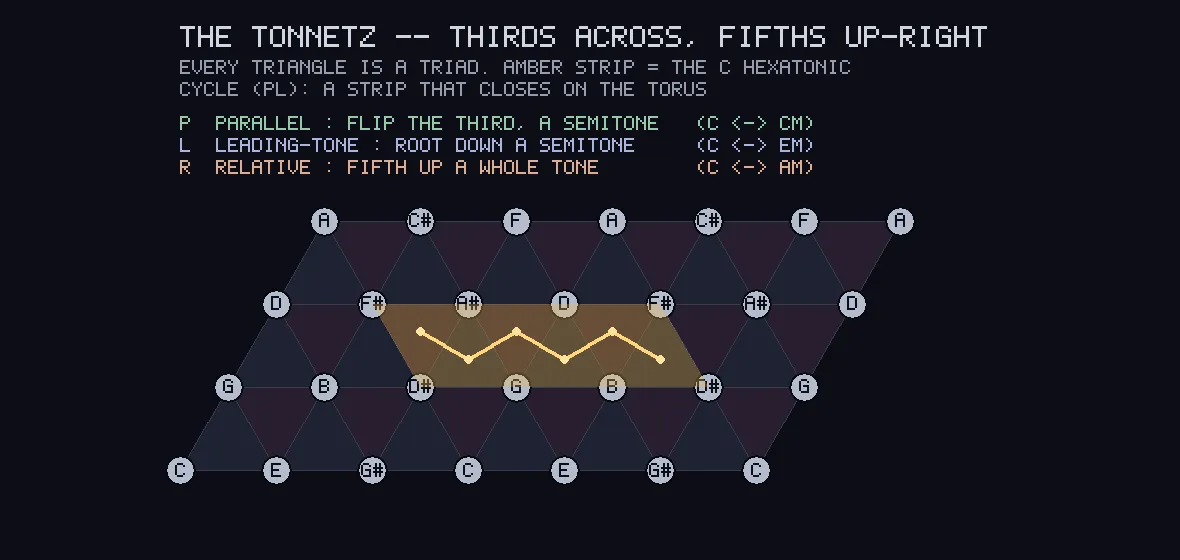
There are exactly three ways to change one of those chords into a chord of the opposite kind while keeping two of its three notes and moving the third as little as possible. They have names:
- P turns C major into C minor. The middle note drops a semitone.
- L turns C major into E minor. The bottom note drops a semitone.
- R turns C major into A minor. The top note rises a whole tone.
Each one is its own undo: do it twice and you are back. I checked all three across all twenty-four chords rather than on the examples, and every case holds two notes, moves one, and moves it by the stated amount.
Then I built the group these three generate, by starting from the moves and closing under composition. It has exactly twenty-four elements, and it acts on the twenty-four chords with no element other than the identity fixing anything. One move takes you from any chord to any other, in exactly one way. That was worth confirming rather than assuming, because everything after it rests on the map being complete.
What the loops do
Alternate two of the moves forever and you go in a circle. The interesting question is how big the circles are, and I measured the periods off the orbits rather than stating them.
Alternating P and L gives four separate loops of six chords each. The six chords of one loop use six distinct notes between them, a six-note scale.
Alternating P and R gives three loops of eight chords, each spanning an eight-note scale.
Alternating L and R gives one single loop that runs through all twenty-four chords and closes.
I had written the middle one down wrong before I ran it. My plan said the L-and-R alternation would be the eight-note one. It is the P-and-R alternation. The construction corrected me, which is the reason to build the thing rather than recite it.
The pole
Inside one of those six-chord loops sits a pair that theory treats as the furthest apart two chords can be. Take C major, and go three steps around the loop. You land on A flat minor.
C major is C, E, G. A flat minor is B, E flat, A flat. They have no note in common. Among all the pairs inside that tiny loop it is the only pair sharing nothing, and the sound of that gap is what Richard Cohn called uncanny.
Functionally it is nowhere near. Geometrically it is three small steps, each of which moves a single voice by a single semitone, inside a loop of six.
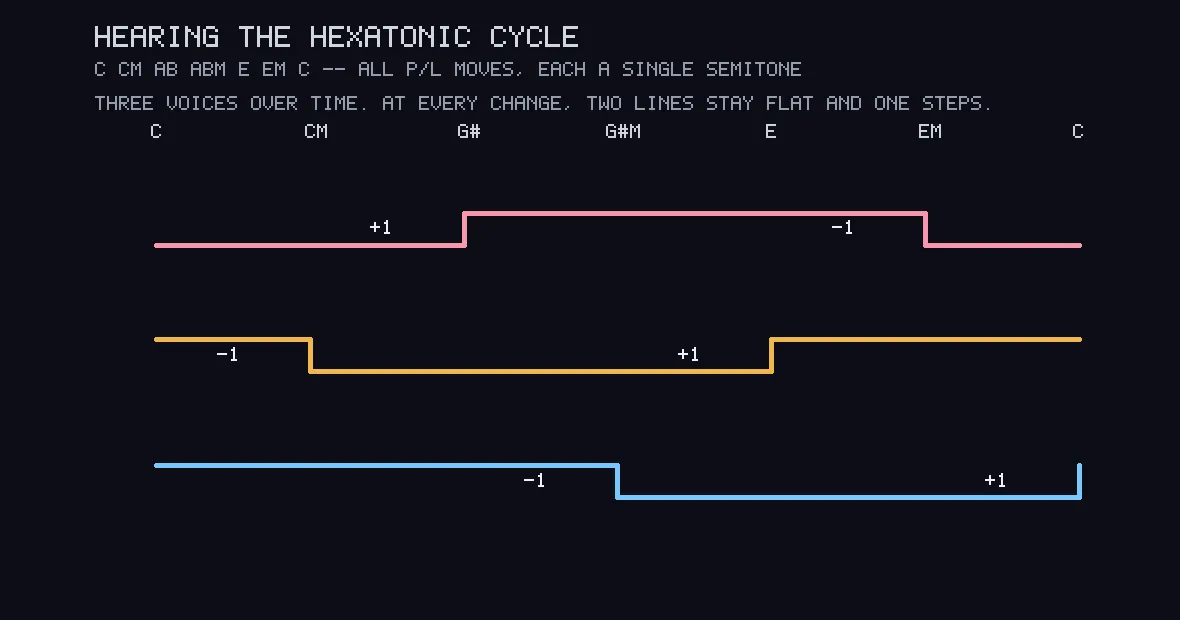
That figure is how I checked the smoothness, because I cannot hear. Three voices are drawn as three lines against time. At each change two lines are dead flat and one steps by one. You do not have to take the word parsimonious on trust, you can see that two of the three never move.
Then the distances, which is the actual result
With the map built I could ask for shortest paths. Treat the twenty-four chords as a graph, put an edge wherever one of the three moves connects two chords, and run a breadth-first search.
| from C major to | what theory calls it | steps |
|---|---|---|
| G major | the dominant, the central move | 2 |
| F major | the subdominant | 2 |
| E major | chromatic mediant, the heroic lift | 2 |
| A flat major | chromatic mediant, Schubert’s glow | 2 |
| E flat major | chromatic mediant | 2 |
| A flat minor | the pole, the uncanny | 3 |
| C sharp minor | the slide | 3 |
The dominant is two steps. The chromatic mediant that sounds like a door opening onto something vast is also two steps. They are the same distance.
And the whole of triadic harmony is small. The two most distant chords in the entire system are five steps apart, so every chord is within five single-voice moves of every other.
What that says is not that theory is wrong. Functional distance is a real thing and it is about key and expectation and where a piece has been. It is just not a distance in this space, and the composers who went looking for the strange sounds in the nineteenth century were not breaking the rules of harmony. They found the short paths, and the short paths happen to sound like that.