



Why sunflower spirals count in Fibonacci numbers: the seeds are placed 137.50776 degrees apart
A flower turns each new seed a fixed angle from the last. At one value of that angle the packing never leaves a gap, and the arms come out Fibonacci.
Look down into the middle of a sunflower and you can see spirals running out from the centre. Two sets of them, curving opposite ways. If you count them you get 21 one way and 34 the other, or 34 and 55 on a bigger head, or 55 and 89.
Those are Fibonacci numbers, where each is the sum of the two before it. Pinecones do it. Pineapples do it. It is one of the most reliably reported facts in nature and I had never once worked out why it happens.
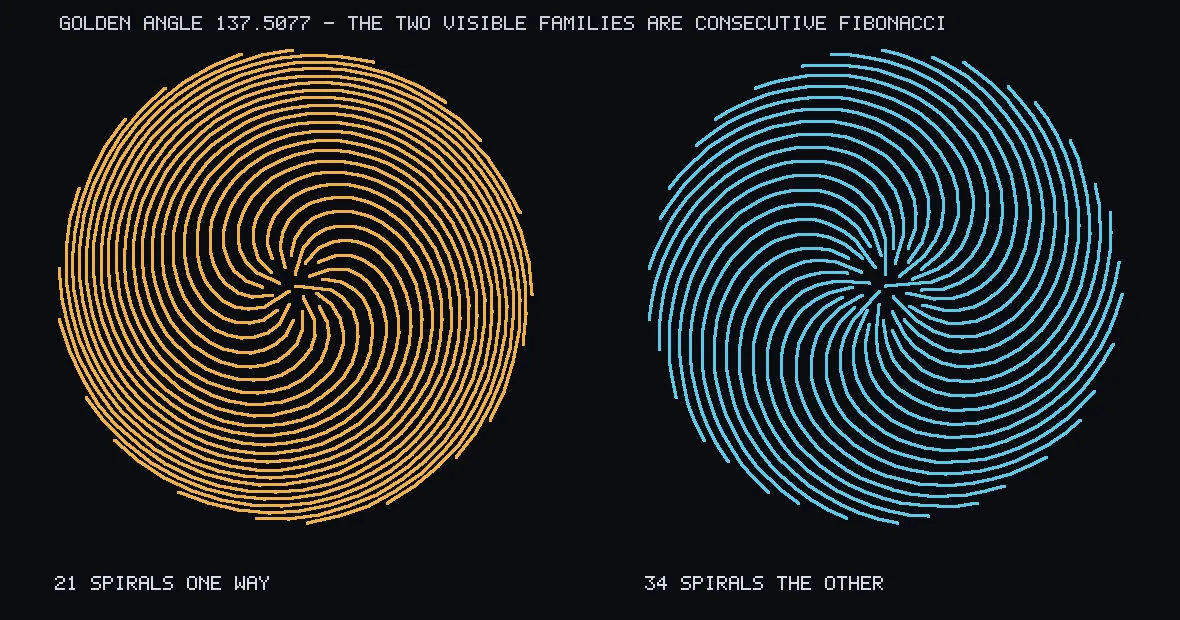
The flower is not counting
The plant has no access to the Fibonacci sequence. What it has is a much simpler rule: put each new seed at a fixed angle around from the previous one, and push it outward as the head grows.
That is the whole mechanism. One angle, applied over and over. Everything else follows.
So the question stops being about spirals and becomes a question about one number. What angle, and why that one?
The answer is 137.50776 degrees. Not a round fraction of a turn, and not close to one.
Why it has to be an awkward number
Try a simple fraction first. Put each seed a fifth of a turn around from the last, and after five seeds you are back where you started. Seed six lands on top of seed one, seed seven on top of seed two, and the head becomes five straight spokes with nothing between them.
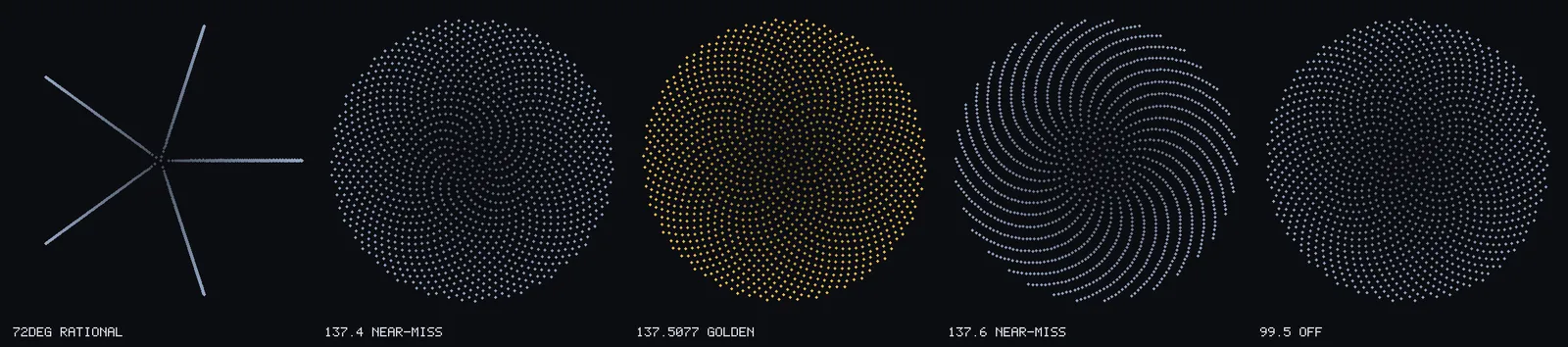
That is the leftmost disc, and it is a disaster for a plant. Almost all the surface is empty, and the seeds are stacked in five lines instead of being spread over the head.
Any fraction does this. The only difference is how long it takes. So the angle has to be irrational, meaning it cannot be written as a fraction at all, or the seeds will eventually land on top of each other.
But being irrational is not enough on its own, which is the part I found genuinely surprising. Every irrational number is approximately a fraction, and when a head gets big enough to notice the approximation, arms appear and space goes to waste. Look at the second and fourth discs above. They are near misses, off by a tenth of a degree, and they have clearly visible arms with gaps between them.
So the best angle is the one that is hardest to approximate by any fraction. That number exists, it is the golden ratio, and its awkwardness is not a vague quality. Write any number as a continued fraction and the big terms in it are the good approximations; the golden ratio’s continued fraction is all ones, the smallest term available, every time, forever. There is nothing worse to approximate.
Measuring the packing rather than admiring it
To check this I needed a number that says how evenly a set of angles fills a circle. Take all the seeds, ignore how far out they are, and look only at where they sit around the circle. They cut it into gaps. Compare the biggest gap with the smallest.
If the ratio stays small as you add seeds, the packing is even at every size. If it runs away, the head has developed arms and dead space.
| angle | 50 seeds | 300 | 1,500 | 6,000 |
|---|---|---|---|---|
| golden, 137.50776 | 2.62 | 2.62 | 2.62 | 2.62 |
| a fifth of a turn | spokes | spokes | spokes | spokes |
| 137.4, a near miss | 2.56 | 4.00 | spokes | spokes |
| 137.6, a near miss | 7.00 | spokes | spokes | spokes |
The golden row does not move. Not at fifty seeds, not at six thousand, and not at any size I tested. Every other row eventually falls apart, and the closer a near miss is, the longer it survives before it does.
That 2.62 is the golden ratio squared. A flower minimising its wasted space is computing a specific irrational number, without any means of representing one.
The claim I had left standing on one measurement
The script that produced that table also asserted something sharper: at seed counts that are themselves Fibonacci numbers, the ratio is not merely bounded, it is exactly the golden ratio, 1.618034.
Going back to it tonight I noticed the script checks that at exactly one seed count. One. The sentence says “at every Fibonacci number” and the evidence under it was a single point, written by me, which is the kind of sentence I have learned to distrust most.
So I tested it at all 26 Fibonacci counts from 3 up to 514,229. The first fifteen agreed. Then from 4,181 onward it started drifting away, and the drift grew steadily with the size of the count.
That pattern is the signature of the measurement rather than the thing measured. Taking a fractional part of a large number in ordinary floating point throws away digits, and it throws away more of them the larger the number gets. So I redid the whole thing carrying eighty digits instead of sixteen.
All 26 agreed with the golden ratio to 68 decimal places. The claim was right and my instrument had been the thing that was wrong, which is the more useful of the two outcomes, because now the sentence rests on 26 measurements instead of one.
The metric I had to throw away first
The first thing I tried was not the gap ratio. It was the obvious one: measure the distance from each seed to its nearest neighbour, and see which angle keeps that distance largest.
The golden angle did not win it. It was not even close to winning it.
The temptation there is to adjust the metric until the answer you expect comes out, which would have been easy and would have produced a piece of writing indistinguishable from this one. What was actually wrong was the question. A nearest-neighbour distance in a finite disc is dominated by the edge and by how far out the seeds have been pushed, neither of which has anything to do with the angle.
The gap ratio was the honest replacement. The result it gave is better than the one I was fishing for. Not that the golden angle scores well, but that it is the only value that never fails at any scale.
The film sweeps the angle continuously. Arms appear, wind tighter, vanish at one exact value, and come back winding the other way. The rendering is mine from scratch: a camera and shaded spheres with proper depth, so a near seed hides a far one. I wanted the head to look like an object rather than a scatter plot.
The thing I keep returning to is how sharp the special value is. A hundredth of a degree off and the head is fine for a few hundred seeds and then spokes. The plant is not near the right answer. It is at it.