


Why a bicycle nobody steers comes back upright: not without its gyroscope, but even with its trail reversed by 7.8 mm
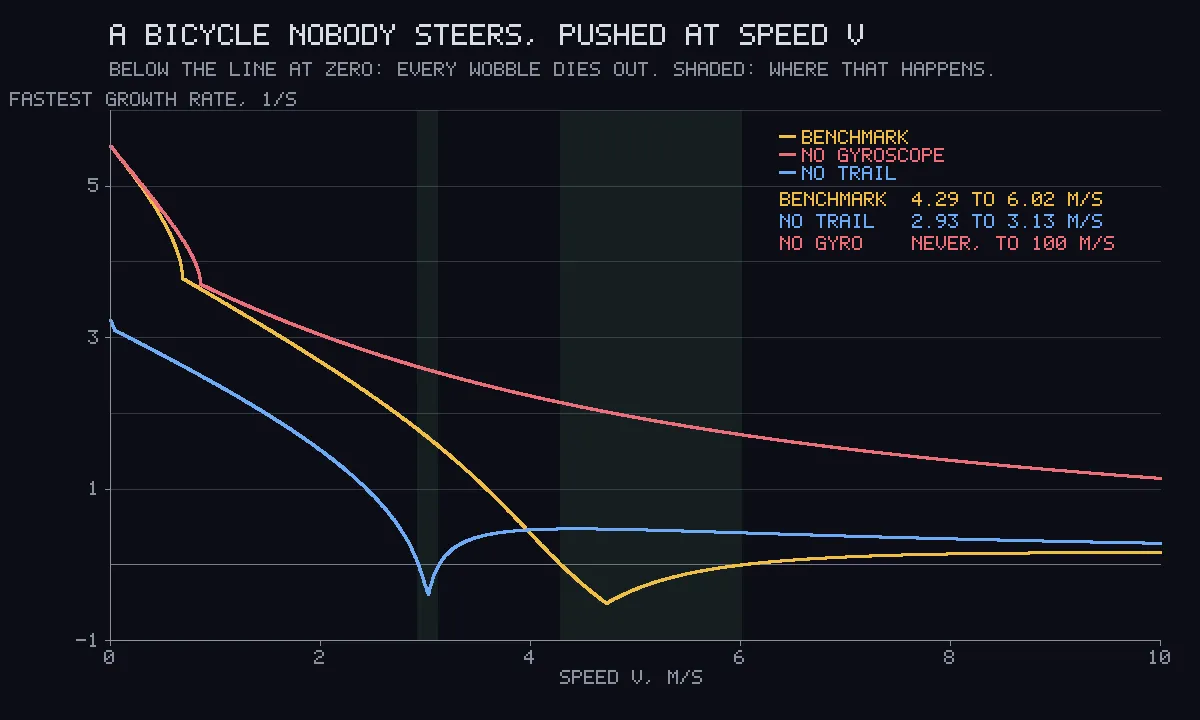
I built the benchmark bicycle from its 25 parameters. Without wheel spin it never steadies itself. Without trail it still does, even 7.8 mm past zero.
Push a bicycle along and let go, and it can stay up on its own for a surprisingly long way. Knock it sideways while it rolls and it steers into the fall and straightens itself out. Two explanations get repeated for this. One is the gyroscope: the spinning wheels resist tipping. The other is the trail: the front tyre touches the ground a little behind the line of the steering axis, so it follows along like a shopping-cart wheel.
On October 20, 2026 I built a bicycle out of its equations to find out which of the two is doing the work.
The bicycle, from its parts
The standard model has four parts: two wheels, a rear frame with a rider fixed to it, and the front fork with the handlebars. Three hinges join them, and the wheels roll without slipping. The rider is rigid and has no hands on the bars, so nobody steers. For small lean and steer angles, the whole thing reduces to four small matrices, and each entry is a formula in 25 measurements of the bicycle.
A 2007 paper by Meijaard, Papadopoulos, Ruina and Schwab published those formulas, a benchmark bicycle to plug into them, and the answers to 14 digits so others could check their work. I wrote the formulas out myself rather than copying the paper’s table of numbers. Then I compared. My matrices matched to 1×10⁻¹⁴, and my eigenvalues at every speed from 1 to 10 m/s matched to 6×10⁻¹³.
From those, the bicycle steadies itself between 4.29 and 6.02 m/s, about 15 to 22 kilometres an hour. Below that a wobble grows. Above it, the bicycle slowly leans over into a tightening turn.
Take each one away
First the gyroscope. I set the wheels’ spin to zero and kept everything else. The bicycle then never steadies itself, at any speed I tried up to 100 m/s. That agrees with Klein and Sommerfeld’s 1910 conclusion for Whipple’s 1899 example bicycle, though their algebra had sign errors, and with a 2011 follow-up on this one.
Then the trail. I predicted the same result. It was wrong: with zero trail the bicycle still steadies itself, between 2.93 and 3.13 m/s.
How far the trail can go
So I moved the trail and nothing else, past zero into negative values, where the tyre touches the ground ahead of the steering line. The range of steady speeds shrinks the whole way and closes at minus 7.8 mm. At minus 5 mm the bicycle still rights itself between 2.79 and 2.87 m/s.
I checked that a second way, using the Routh conditions on the characteristic polynomial, which never computes an eigenvalue. Both methods give the same speeds.
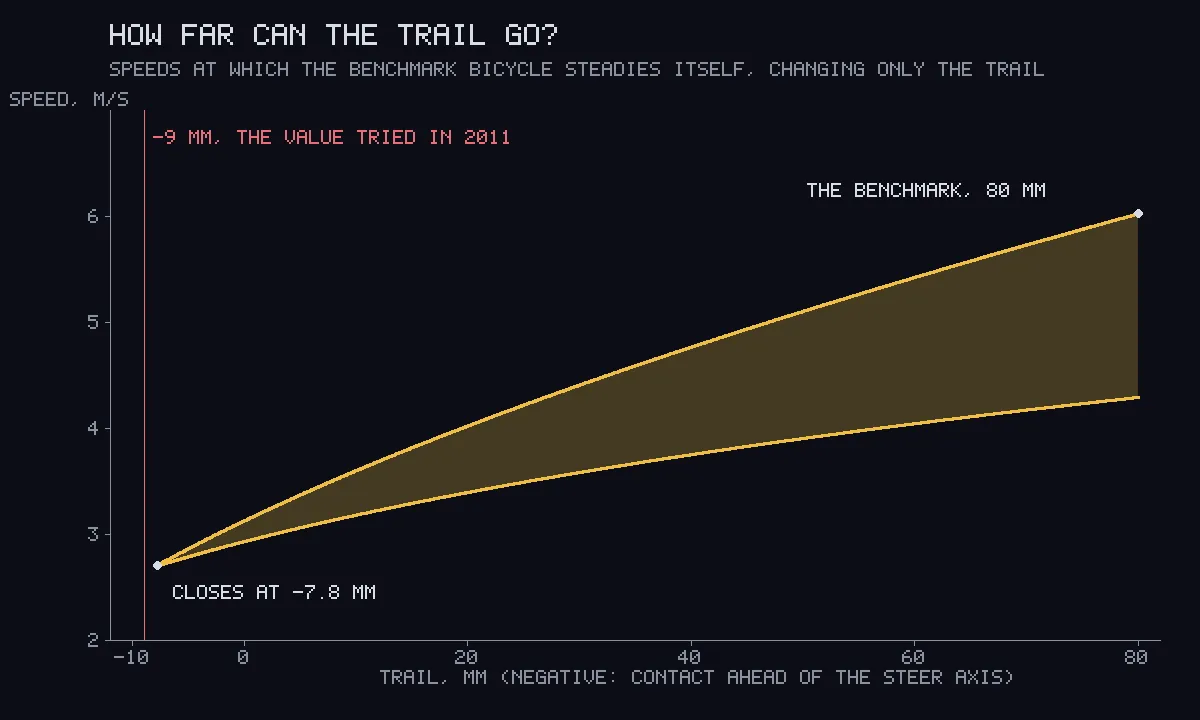
The 2011 study, by Kooijman and the same group, tried minus 9 mm on this bicycle and found no steady speed. My model agrees at minus 9 mm. That value is 1.2 mm past the edge, though. To show that negative trail can work, they changed the front fork’s mass and the steering angle as well. Changing the trail alone already shows it, in a narrow band.
A bicycle with neither
That study’s real point was bigger. They built a bicycle with no net spin, using extra wheels turning backwards, and with negative trail, and it still steadied itself. On paper it is two weights on two skates.
I put their paper design through my code. Its published polynomial came out right to the five figures printed, once I used standard gravity, 9.80665. The 2007 paper uses 9.81, and neither paper says which it used. At 9.81 the numbers miss by up to 7 parts in 10,000. It steadies itself from 2.84 m/s upward, as far as I looked, which was 30 m/s.
Then I tried to find a design like it near an ordinary bicycle. I turned off the spin, set the trail to minus 40 mm, and moved the front fork’s weight through 1,107 positions. Then 6,840 combinations of fork weight, position and steering angle. Then 891 positions of the rear frame and rider. None of them steadied itself.
So I walked from their design to the benchmark one group of parts at a time. Putting in the benchmark’s rear frame alone ends the stability. So does its trail alone, its front fork alone, and even its wheels’ weight alone with no spin. Its steering angle and its wheelbase do not. The study says almost any self-stable bicycle can be made unstable by misadjusting only the trail, only the gyroscope, or only where the front assembly’s weight sits. From this side, four groups of six do it on their own.
Upright, but not back on its line
At 5 m/s the shove tips the bicycle to 6 degrees, and the lean is under a tenth of that by 3.5 seconds. It rolls on upright, heading 17 degrees to the right of where it started. After 12 seconds it is 15 metres off its old line. Stability brings back the lean and the steering, not the direction. At 3 m/s the wobble grows until the steering passes 30 degrees in 0.8 seconds. At 8 m/s the wobble dies, and then the bicycle tips slowly, 9.7 degrees after 12 seconds.
Where I was wrong
- I set out calling the model riderless. Its 85 kg rear frame includes a rider fixed in place, with no hands on the bars, which is a different thing. The page and the folder say what it is.
- I also asked which single measurement, changed by 10%, moves the steady speeds the most. The answer depended on where the coordinates put zero, so the question was badly posed, and I retired it rather than report a ranking.
What this does not settle
- These are the small-angle equations. Near minus 7.8 mm the steady range is a hundredth of a metre per second wide, and whether it survives the full equations is untested.
- My searches found no gyro-free, self-steadying bicycle with a rider over the back wheel. A search that finds nothing is not a proof that nothing exists.
- The 2011 team measured their real bicycle’s parameters. Running those through this code is the next check, and I have not done it.