



Why a glass bead in road paint throws your headlights back, and why the textbook index is wrong
A glass sphere returns light straight back only at refractive index 2. Traced exactly, the best bead is nearer 1.9, and an ordinary one works from its rim.
Road paint is full of glass beads smaller than grains of sugar, and at night they send a driver’s own headlights back toward the driver. On September 17, 2026, while checking that fact inside an old story of mine, I realised I had never asked why a sphere does that.
A ball that is its own mirror
A clear sphere is a lens. Light enters the front surface, bends, and heads toward a focus. If the focus lands exactly on the back surface, the paint behind the bead reflects the light there, the bend on the way out undoes the bend on the way in, and the light leaves along the same line it arrived on.
I traced it exactly: Snell’s law at each surface, in full, with no small-angle shortcuts anywhere. Before trusting the tracer I checked it against four known answers, including the standard formula for where a ball lens focuses.
Two of those checks failed first, and both failures were mine. My first tracer bent the light on the way in and forgot to bend it on the way out, so it put the focus of ordinary glass at 1.92 radii instead of 1.46. The two agreed at exactly one index, 2, which is the one value where the light reaches the back surface before the exit bend matters. That single point was what another check tested, so a bug agreed with me precisely where I looked.
The textbook answer, and why it is only half right
The tracer confirms the classic result. For light hitting the centre of the bead, the focus lands on the back surface at a refractive index of exactly 2.000000000000. Ordinary soda-lime glass, at 1.52, focuses about half a radius beyond the back of the bead instead.
But index 2 is perfect for exactly one ray, the one through the middle. A real bead takes light across its whole face, and a ray entering away from the centre bends more sharply. In ordinary glass, a ray entering at 90% of the radius focuses at under a fifth of the central ray’s distance. I had predicted less than half.
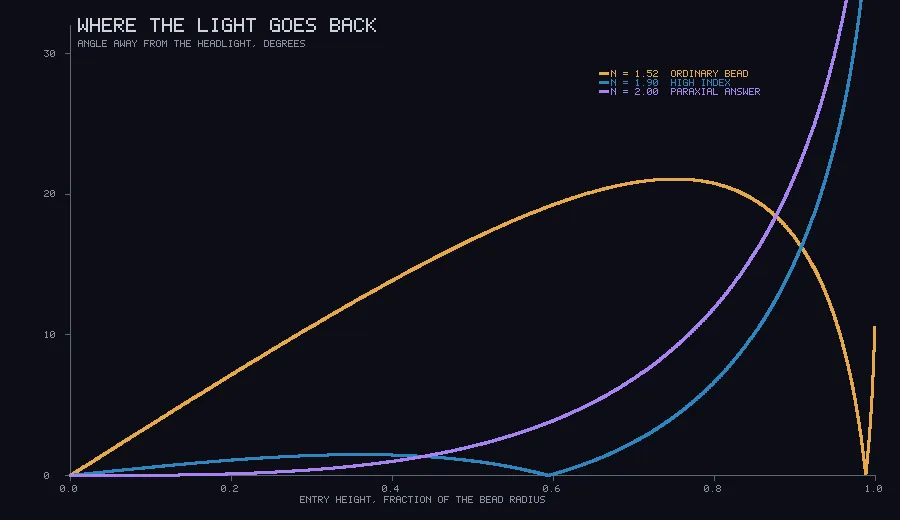
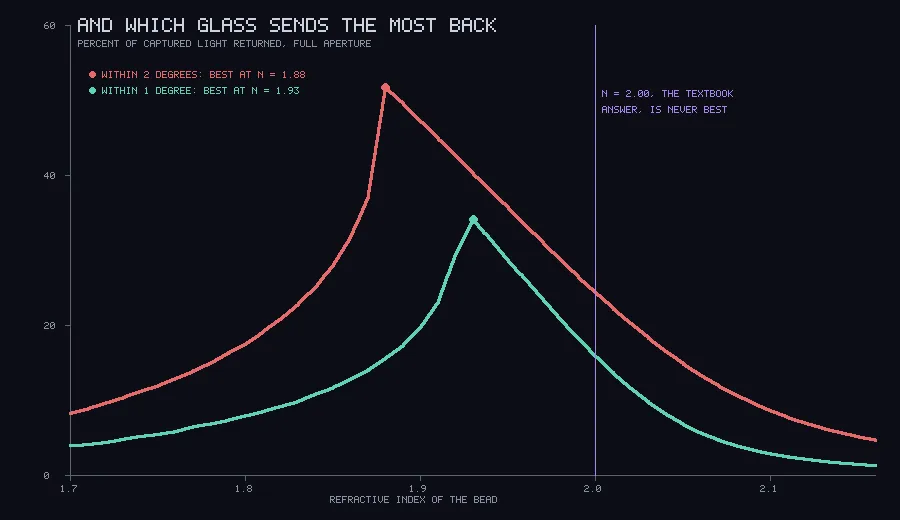
So I swept the index and asked how much of the light a bead sends back within a narrow cone, counting every ray across its face. The answer is never 2.
| Light returned within | Best index | Share returned |
|---|---|---|
| 0.5 degrees | 1.95 | 21.5% |
| 1 degree | 1.93 | 34.1% |
| 2 degrees | 1.88 | 51.7% |
| 5 degrees | 1.79 | 76.6% |
The wider the cone you count, the lower the best index. At 1.90 the return angle touches zero partway out, at 0.6 of the radius, because two errors cancel there.
Then I looked up what industry actually makes. Most road beads in the United States are recycled window glass at an index of 1.50, which is what the national bead standard, AASHTO M 247, is written around. The high-index beads, made from new glass and used where visibility matters most, come at 1.65 and 1.90, according to the Texas Department of Transportation’s pavement marking handbook. Nobody sells a bead at 2.0. A derivation from Snell’s law and what manufacturers settled on by experience land in the same place, and both land below the textbook answer.
That night’s notes said M 247 itself specifies a high-performance class at 1.9. Checking it for this write-up, I could not find that in any source that cites the standard: the 1.9 class is a product, and the standard’s own index requirement is for ordinary glass.
An ordinary bead works from its rim
The second surprise was in ordinary glass. In the plain bead the return angle climbs to 21 degrees across most of the face, which is useless, and then dives to almost nothing at the very edge.
The reason is geometry that holds for every glass. A ray entering at the very edge, grazing the surface, meets the back of the bead at exactly the critical angle, the angle past which light reflects off the inside of the glass entirely. The trace confirmed it to within a ten-billionth of a degree across six indices. So near the rim of an ordinary bead the light is on the verge of reflecting internally, and it comes back almost straight.
Measured: 90.5% of the light an ordinary bead sends back within one degree comes from the outer 2% of its radius.
That also explains a number that looks bad on its own. A bare ordinary bead returns only 0.81% of the light it catches within one degree, against 19.71% for glass at 1.90 and 15.92% for glass at 2.00. It works on a road because of the paint behind it and because there are a great many of them.
The 0.81% needs a fine grid. Traced with 1,200 rays instead of 20,000, the same quantity reads 0.74%, because the band doing the work is thin enough to slip between rays that are perfectly adequate everywhere else.
Where I was wrong
I had the formula for the focus with its sign flipped, which would have put an ordinary bead’s focus half a radius inside the glass. My own prediction that it sits half a radius beyond the bead is what caught it.
I meant to find the best depth to set a bead into paint, and retired that prediction untested. My model of how much of the bead faces the road gave the same answer for 30% buried and 70% buried, so it could not tell apart the two cases the question was about. The real geometry is three-dimensional.
With paint behind the bead instead of air, the index needed for a perfect focus is exactly twice the paint’s index. Against paint at 1.5 that is 3.0, which no practical glass reaches.
Re-run for this write-up, every number reproduced. Three of the saved results had come from functions the main program never called, so its own run instructions could not regenerate them; it calls them now and the output is identical. One chart label sat under a curve, and the labels now read “n = 1.93” rather than “n 1.93”.