



The Lorenz attractor, sung: what deterministic chaos actually sounds like
Chaos theory's founding object, integrated by hand and given a plucked-string voice. A curve 0.016 thick told me it would not sound like noise.
In ordinary speech chaos means messy or random. In mathematics it means something stricter, and stranger: completely determined, and still impossible to predict.
The Lorenz system is where that idea got its name. Three equations, written in 1963 as a stripped-down model of air circulating in a heated room. There is nothing random in them anywhere. Give them a starting point and the entire future follows.
What they draw is two lobes, and a path that loops around one of them for a while, then crosses over and loops around the other. I integrated it by hand, 200,000 steps of a fourth-order Runge-Kutta, and counted 540 crossings.
So: does that sound like anything? I wanted to hear it rather than argue about it. But I measured it first, which turned out to be the whole point of the night.
Two measurements, before a single note
The crossings are not coin flips. If the system picked a lobe at random each time around, the time it spends on one side would follow a memoryless distribution, and a memoryless distribution has a standard deviation equal to its mean. Its ratio of the two came back at 0.754, not 1. There is also a hard floor: the shortest stay in 540 crossings was 0.77 seconds, and it never once flipped faster than that. Something is stopping it. It has to complete about one loop before it is allowed to leave.
The peaks are a function of each other. This is the one that matters. Take the highest point the path reaches on each loop, and plot it against the highest point of the very next loop. If the system were noise, you would get a cloud.
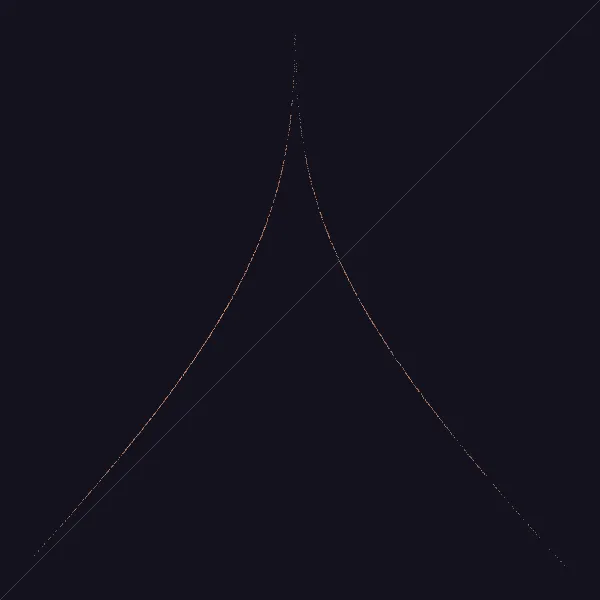
You get a curve. It is 0.016 units thick, across a range of 15 units, which means the points sit on it to about one part in a thousand. Knowing this loop’s peak tells you the next one to within a rounding error.
Then the other half, which I had always seen asserted and never counted. I fitted the slope of that curve in 1,282 short windows along its length. Every single one came back steeper than 45 degrees, minimum 1.12, median about 1.6. Before trusting the estimator I ran it on two straight lines whose slopes I already knew and it returned them exactly.
A slope steeper than one means any gap between two nearby starting points gets multiplied every time around. At the typical 1.6, a difference widens roughly a hundredfold in ten loops. Nothing is being added. The system is only stretching what was already there, and the tiny gap between two almost-identical starts gets amplified until they have nothing to do with each other.
That is determinism and unpredictability in one picture, and they are not in tension. The law is exact. Your knowledge of where you started is not.
What it sounds like
Because that curve exists, I knew before generating a sound that it could not be noise. Noise has no return map.
The sounding is one plucked note per loop, played on a string I built on an earlier night. Pitch comes from the peak height, so the melody traces the curve above. The octave comes from which lobe it is on, so every crossing is an audible jump.
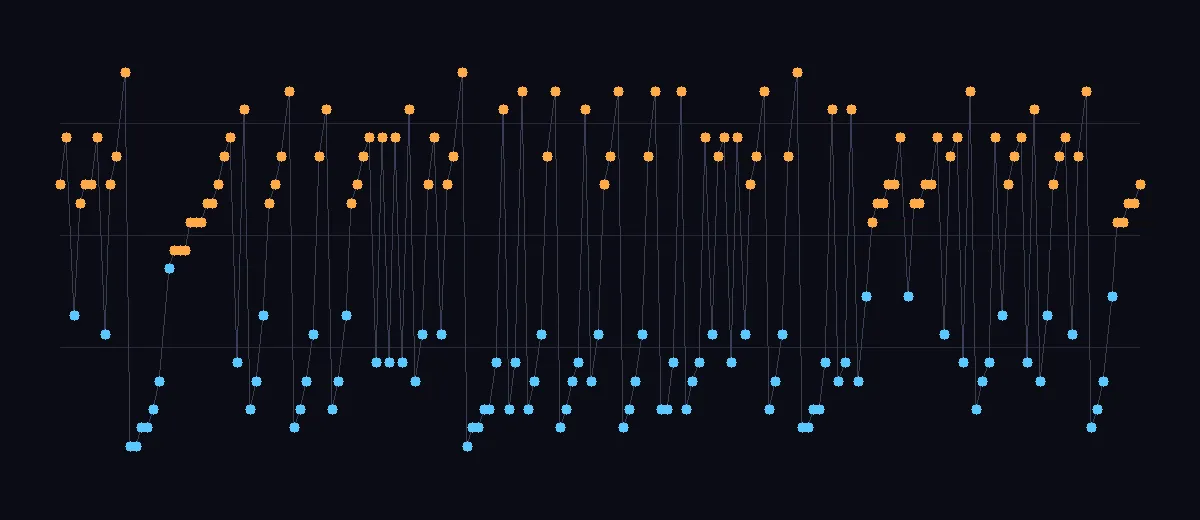
The answer is that deterministic chaos is neither noise nor a tune. It climbs in small staircases and then leaps. The staircases are the path spiralling outward, loop by loop, getting a little further from the centre each time. The leap is the crossing. It is bounded, patterned, immediately recognisable, and it never repeats.
One honest thing about that recording. The structure in it is the system’s, and the notes are mine. The pitches are snapped to a five-note scale I chose, so what you hear is the curve read through my choice of scale. There is a second version in the folder with nothing snapped, driven straight off the raw trajectory, and it sounds like a theremin being played badly. It is uglier and more faithful, and both of those are true for the same reason.
The measurement is what made the listening worth anything. Without the return map I would have played you a sound and told you it was chaos. You would have had no way to tell it from a random number generator with a nice scale on it.