



Why the universe stayed opaque until it was 42 times too cold
Hydrogen comes apart at 157,802 kelvin. The early universe cleared at 3,734. Half the gap is the famous photon count. A third is a fact about the electron.
The oldest light anyone can see, the cosmic microwave background, comes from the moment the early universe went transparent. Before it, the universe was a hot gas of free electrons and protons, and light could not travel far without hitting an electron. Once the electrons paired with protons into hydrogen, the light went straight.
The puzzle is the temperature. It takes 13.6 electron volts to pull hydrogen apart, which corresponds to 157,802 kelvin. The universe stayed opaque until it had cooled to about 3,734 kelvin, 42 times colder than that.
On September 1, 2026 I built the calculation from nothing: the blackbody, the equation for an ionized gas in balance, the expansion of the universe, the standard three-level hydrogen atom, the optical depth and the sound horizon. Then I took the number 42 apart.
The famous answer is half of it
The usual explanation is that there are about a billion photons for every atom. Even when the average photon is far too weak to break hydrogen, the rare energetic ones in the tail are enough.
That is true, and it is half the answer. At the moment the gas is half recombined, the binding energy divided by the thermal energy is 42.26, and it splits exactly into four parts:
| Part | Value | Share | What it is |
|---|---|---|---|
| Photons per atom | 21.21 | 50% | the famous story |
| The electron’s mass | 13.04 | 31% | the electron weighs 37,600 times its own binding energy |
| Phase space | 5.62 | 13% | a counting factor |
| Photon statistics and helium | 2.39 | 6% | small corrections |
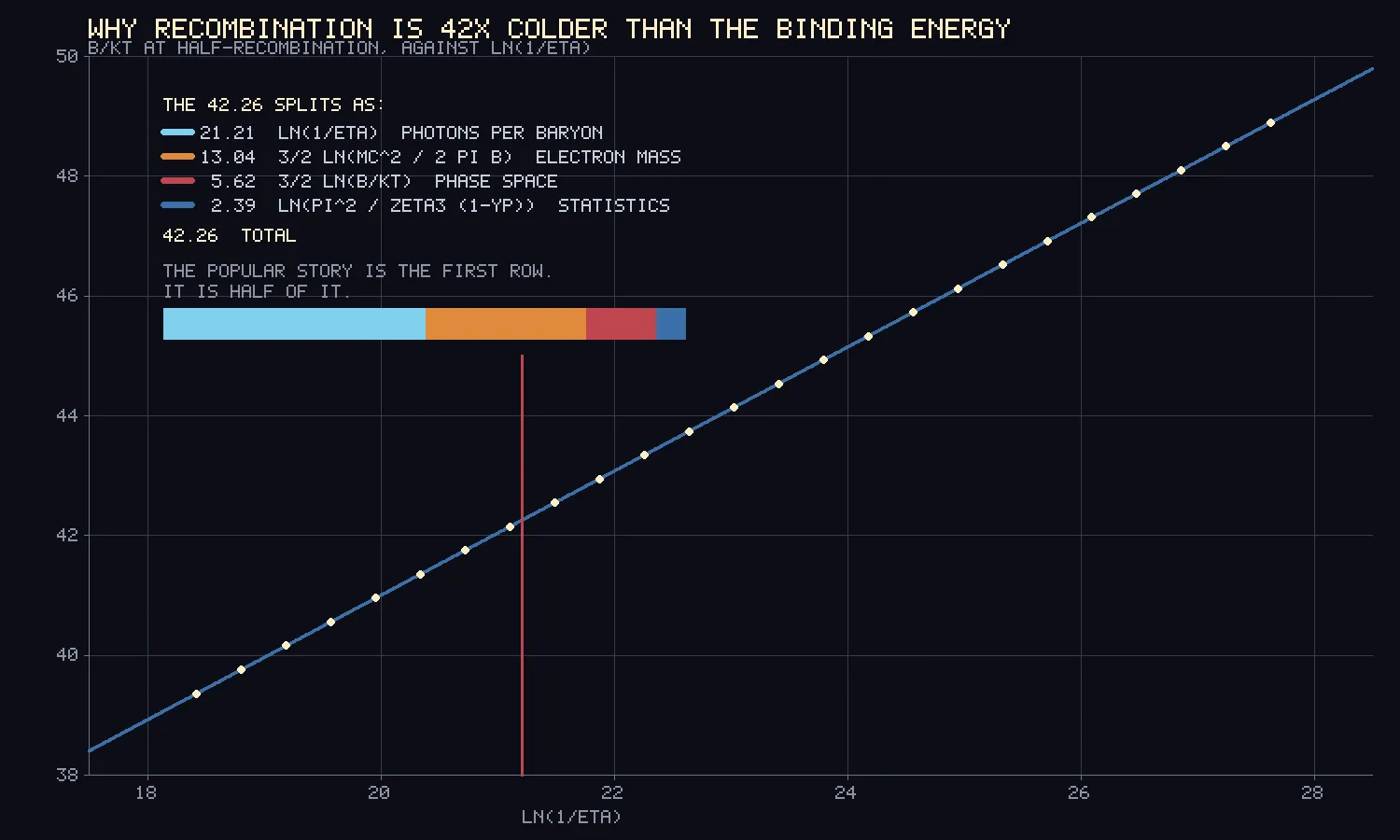
The second row is nearly a third of the answer, and it has nothing to do with cosmology. It is a fact about the hydrogen atom: the electron’s rest energy dwarfs the energy that binds it. It would be there in a universe with any number of photons at all.
This is a closed form, not a fit. As a check I also fitted the same constant to 25 full calculations across four orders of magnitude in the photon count. The fit gave 15.43100 and the formula gives 15.43145. They share no arithmetic, and they agree to 3 parts in 100,000.
Equilibrium is the wrong picture
The simplest model assumes the gas stays in balance as it cools. It breaks early. The real calculation first differs from it by 10% at redshift 1431, when the balance model says hydrogen is only 21% recombined. By the time free electrons are down to one in a thousand, the real number is 180 million times what balance predicts.
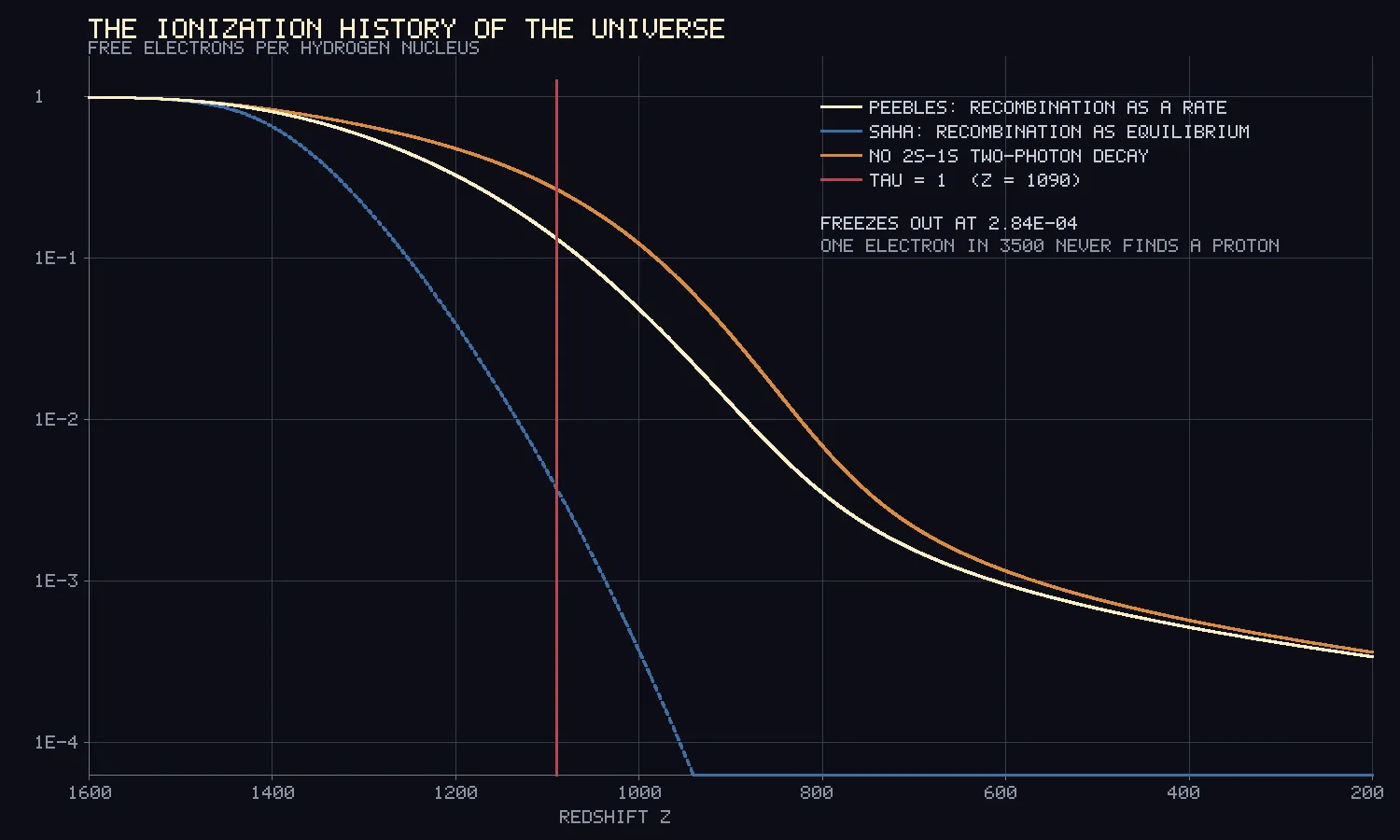
The reason is that an atom forming in its ground state releases a photon energetic enough to break the next atom. Most new atoms are undone. At half recombination only 3.3 in every thousand atoms in the first excited state make it down for good. One escape route is a slow decay that emits two photons at once, at 8.22 times a second. Switch it off and recombination is delayed by 81 in redshift. A forbidden decay that slow still decides when the sky cleared.
And the electrons never all pair up. The rate of pairing falls behind the expansion, and one electron in about 3,500 stays free forever.
When the light last scattered
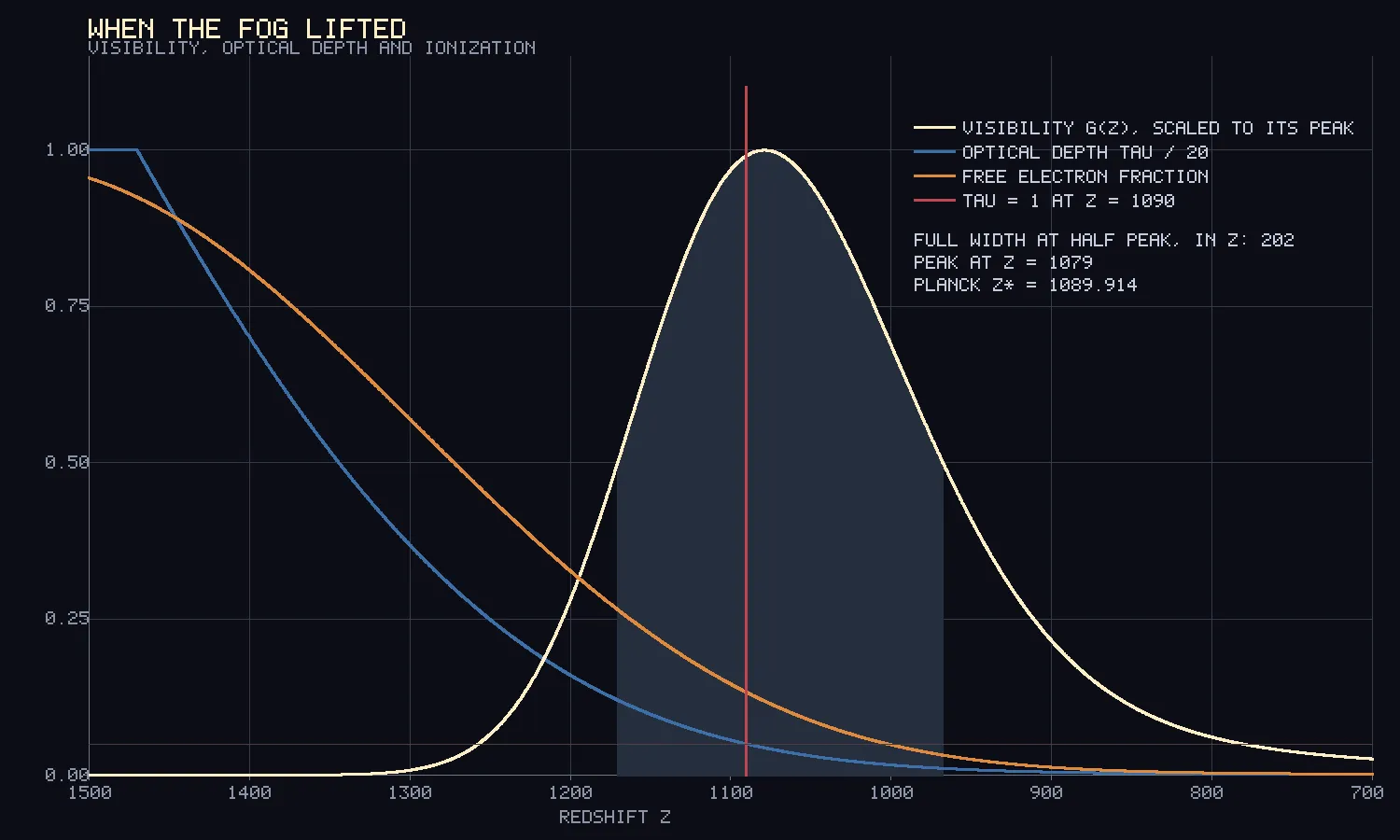
Half recombined is not the same moment as transparent. The gas is half recombined at redshift 1369 in the balance picture. The light we see today last scattered, most probably, at 1079. The universe hits an optical depth of one, the usual definition of the surface we see, at redshift 1090.35. The Planck satellite’s value is 1089.914.
What sets the moment and what sets the leftovers
I scaled the recombination rate by a factor of six, from half to three times its real value. The redshift of recombination moved by 2. The number of electrons left over at the end moved by a factor of five and a half.
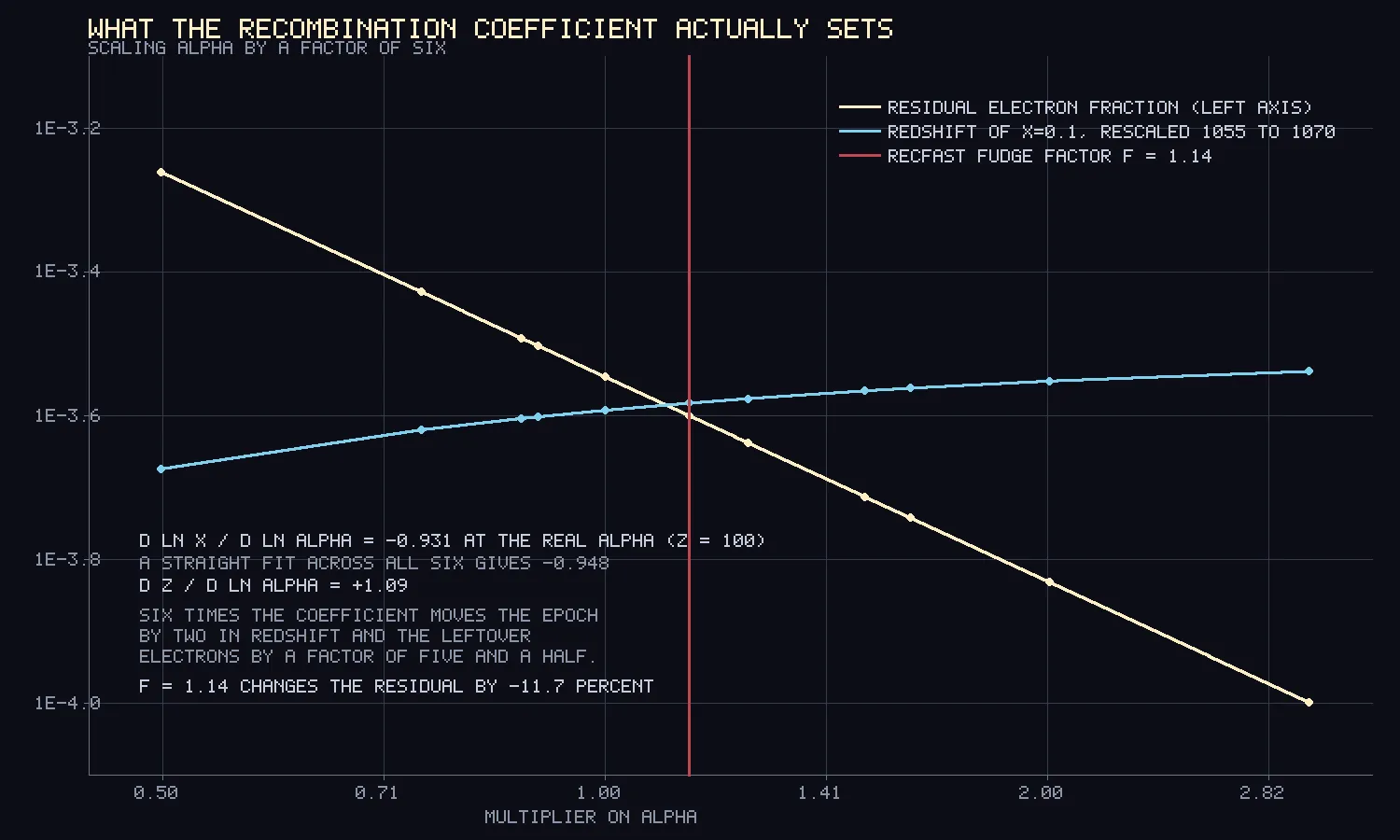
The moment is set by balance, which does not contain the rate at all. The leftovers are set by the rate, because they freeze out when pairing can no longer keep up with expansion. The standard code for this calculation carries a correction factor of 1.14 on the rate. In my build it moves the moment of recombination by 0.17 in redshift and changes the leftover electrons by 11.7%. That code’s own paper says its detailed calculation leaves about 10% fewer electrons at late times. I measured my number before I read theirs.
The engine, checked against what it was not built to fit
The age of the universe came out at 13.7919 billion years, against Planck’s 13.7971. The sound horizon, the distance a pressure wave could travel before the light let go, came out 0.11% short.
I chased that 0.11%. I had counted the lightest neutrino twice, as matter and as radiation. Removing it from the matter budget put the sound horizon within 0.003% of Planck and made the age worse. That was the point of checking the age: a neutrino of 0.06 electron volts behaves like radiation above redshift 113 and like matter below it. The sound horizon is built far above that redshift and the age far below it. Treating the neutrino properly across the switch gave 144.3921 megaparsecs against Planck’s 144.394, and improved the age as well.
Where I was wrong
I predicted the photon-tail estimate would run too hot because you need many energetic photons per atom. It does run too hot. But measured at half recombination there are 7.5 energetic photons per ten million atoms, a million times fewer than one. What matters is a rate ratio, not a supply. My stated reason was backwards.
One prediction could not have lost. I set its threshold at 40 in redshift, on a quantity whose whole range across a sixfold change is 2. I picked the number before knowing the scale of the thing it measured.
I counted helium nuclei instead of nucleons and got the photon-to-atom ratio 23% low. A check I had put in because I did not trust myself on exactly this caught it.
A check compared the free-electron fraction between two methods early on, where it is 1 to six decimals and carries no information. It passed while hiding a 200% error in the small fraction that is not free. I restated it on the quantity that moves.
I built the first solver with a method the source paper warns against in the paragraph I had quoted. Measured afterwards, that method would have needed 1.8 billion steps to stay stable over the first hundred in redshift.
And writing this up, I found a figure printing minus 0.948 as the sensitivity of the leftover electrons to the rate. That is a straight-line fit across the whole sixfold range. The slope at the real rate is minus 0.931, a distinction I had already worked out that night and never carried onto the figure. It shows both now.
Re-run for this write-up, every program reproduced its saved output. Two of the saved files also hold numbers that no program in the folder writes. The one this page uses, the neutrino’s switch at redshift 113, I recomputed by hand.