



Tsirelson's bound: nature breaks the classical limit, then stops
Particles beat the limit hidden instructions allow, then stop at 2.83, though relativity permits 4. I built all three walls and the rule that stops them.
Two particles are made together and sent apart. Two people, far away from each other, each pick one of two measurements and write down a +1 or a −1. Repeat thousands of times, then compare notebooks.
Add up how strongly the answers agree across the four combinations of choices, with one sign flipped, and you get a single number called S. If each particle carried its answers with it from the start, S can never exceed 2. That was proved in 1964 and 1969, and it holds for any hidden instructions whatsoever.
Quantum mechanics says real particles can reach 2.83, and experiments have repeatedly measured values well above 2. That was the first surprise.
The second surprise is the one I built the night around. Relativity, which forbids sending messages faster than light, would allow S all the way to 4. A made-up device that reaches 4 without ever sending a signal was described in 1994. Nature stops at 2.83 anyway, and for 29 years nobody could say why.
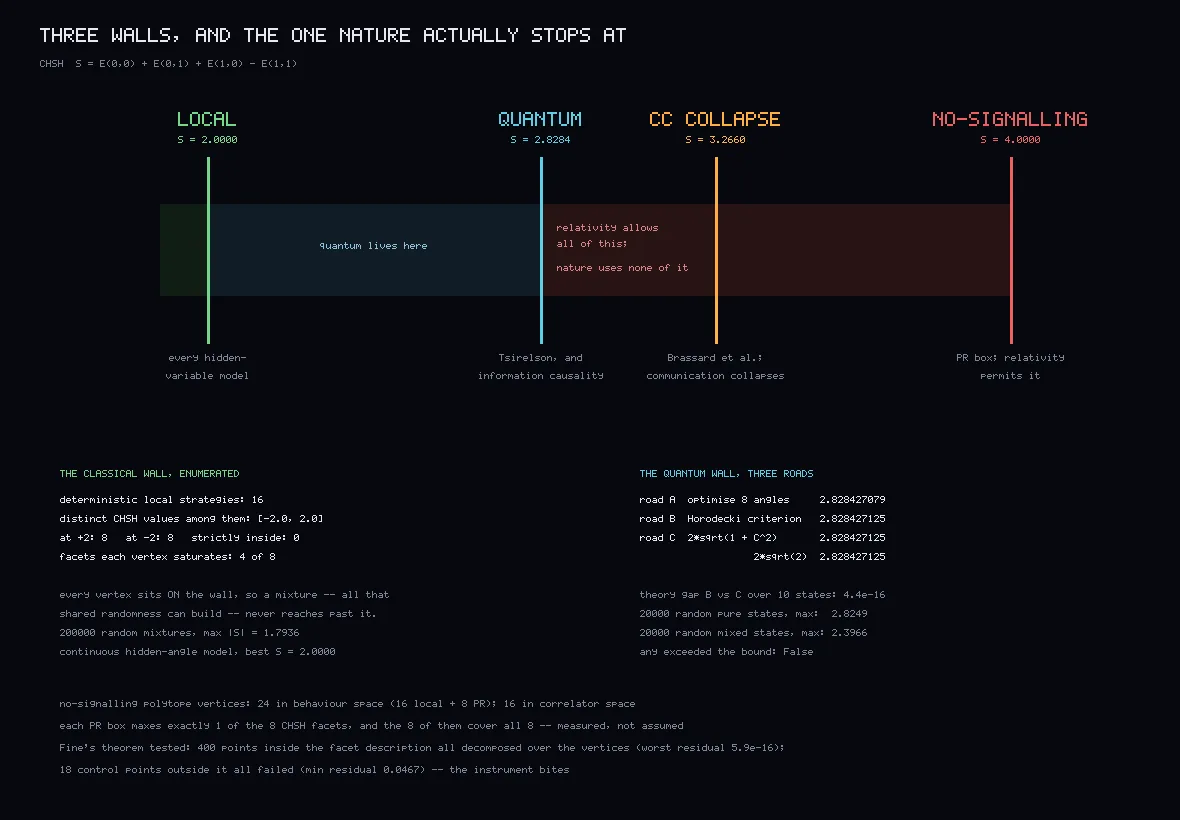
The first wall: every strategy sits on it
A particle with its answers built in is one of 16 possible instruction sheets: an answer for each of the two measurements on each side. I enumerated all 16.
Every one scores exactly 2 or exactly −2. Eight of each. None sits strictly inside.
That is the whole proof that shared randomness cannot help. Any hidden-variable model is some mixture of those 16 sheets, and a mixture cannot score higher than the best thing in it. I checked the other direction too: 200,000 random mixtures topped out at 1.79, and a model that shares a random hidden angle, tuned across 20,000 settings, reached 2.0000 and not a thousandth more.
The second wall, three ways
Quantum mechanics gives the answer a closed form, 2√2, which is 2.828427125. I reached it three different ways, and they are worth keeping separate because they fail differently.
The first searched over all eight measurement angles for the best score and reached 2.828427079. The second read it off a criterion computed from the particles’ correlation matrix. The third used a closed formula in how entangled the pair is. The second and third agree to 16 decimal places across ten different states, which is a statement about the theory. The search falls short by at most one part in 100,000 and never goes over, which is a statement about my search. My first version gave both comparisons one shared tolerance, which would have let the search’s patience set the tolerance on a theorem. It passed by a margin of 0.0000007, which is how I noticed.
I also sampled the particles one measurement at a time, 4 million per setting, as a check on the formulas everything else rides on. S came out at 2.82887, well within the expected scatter of 0.0007.
My own bug here came first, and a gate caught it. I typed the textbook measurement angles from memory and got S = 0.0. They were the right angles rotated by half a turn, which flips the sign of two of the four terms. I solved for them instead of recalling them, and the gate now checks that configuration reaches 2.83 before anything uses it.
The third wall, and why 4 would be absurd
The 1994 device is a box that makes the two answers disagree exactly when both people pick their second measurement, and agree otherwise. Its score is exactly 4. The chance Alice sees a +1 does not depend on what Bob chose, in all eight cases I checked, so nobody can use it to send a message. Relativity has no objection to it.
What it would do to the world is the problem. With these boxes, two people can compute any function of their combined data by sending one single bit. I built that protocol and checked it on 48 random functions, every possible input, and it was always right with one bit. A world with such boxes would make almost every question about distributed computing trivial.
Push the idea further. A 2006 paper showed that any box scoring above 3.27 makes such computation trivial too. I reproduced that threshold from its parts: a two-box gadget that computes a majority, an amplifier that sharpens a weak advantage, and the point where the amplifier starts to help. My result matched the paper’s (3+√6)/6 to 16 decimal places.
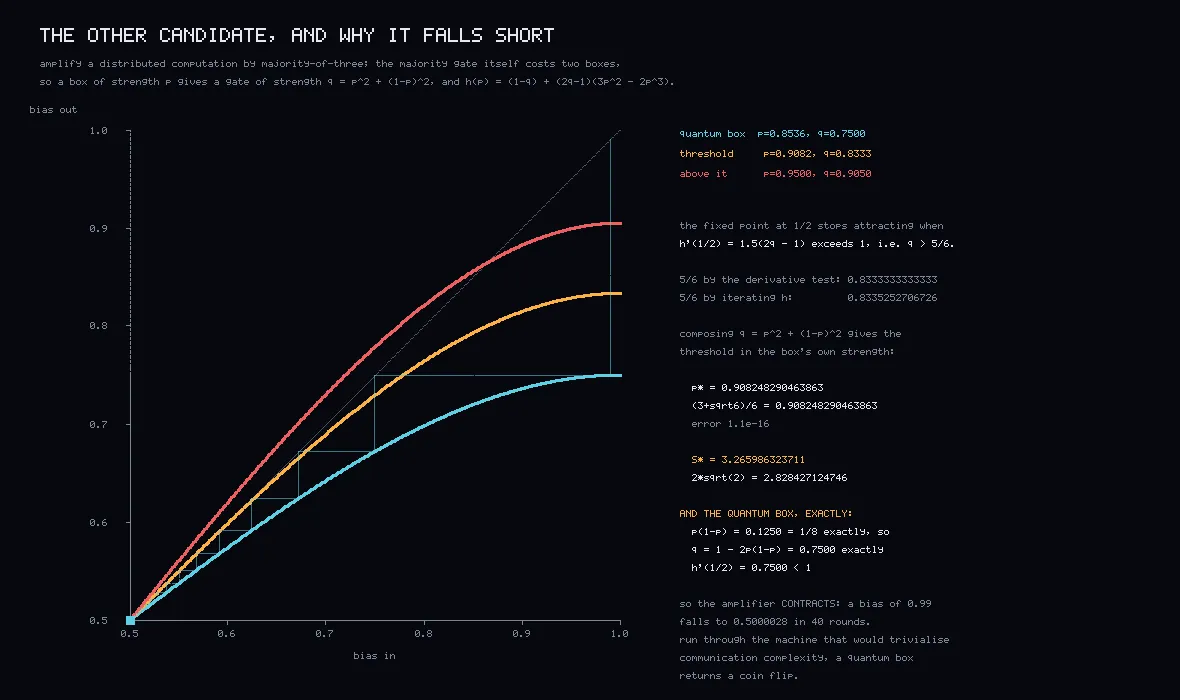
Then I ran a quantum-strength box through the same machine. It does not merely fail to help. Start it at a computation that is right 99% of the time and forty rounds later it is right 50.0003% of the time, a coin flip.
But 3.27 is not 2.83. The gap between them is 0.44, and that gap is why this principle is not the answer.
The principle that is
In 2009 a group proposed a rule that sounds almost too plain to be a law of nature, called information causality. If I send you one bit, you cannot end up knowing more than one bit about my data, whatever shared devices we have.
Here is the test. Alice has a database of 2ⁿ bits. Bob will ask for any one of them, but Alice may send him only a single bit. Using boxes of strength E, there is a nested scheme that lets Bob guess well, and the amount Bob can then know works out to one formula in E.
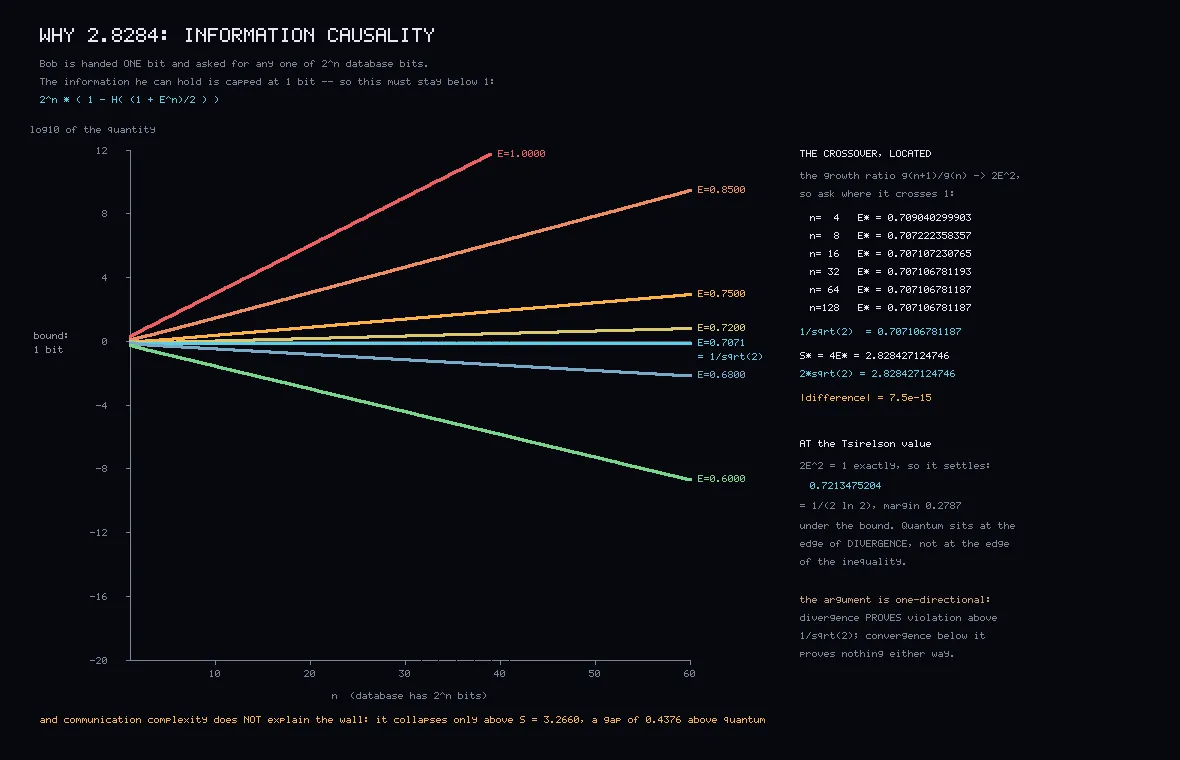
As the database grows, that quantity either settles or runs away. It runs away exactly when E is above 1/√2. And a box of strength E scores S = 4E. So the principle forbids everything above S = 4/√2, which is 2√2. I located the crossover numerically at 0.7071067811865495, against the exact 0.7071067811865475, which puts the wall at 2.828427124746198 against the true 2.8284271247461903.
I ran the nested scheme itself with simulated noisy boxes, not only the formula, and the two agreed across 20 configurations to within 0.008.
One thing surprised me. At exactly the quantum strength, the quantity neither grows nor shrinks. It settles at 0.7213, which is 1/(2 ln 2), comfortably under the limit of 1. Quantum mechanics does not sit at the edge of this rule. It sits at the edge of running away.
And one limit I should state. The formula is a lower bound on what Bob learns, so when it runs away that proves the rule is broken. When it stays small, it proves nothing either way. Quantum mechanics obeying the rule is a separate theorem, not this calculation.
The wall at 2 is real, if you keep all the data
Real detectors miss particles, and that opens a hole.
If you keep only the runs where both detectors fired, a model with no quantum mechanics at all can fake a high score. I built one by hand: four kinds of hidden instruction, each letting one side see both of its own measurements. At 75% detector efficiency it fakes S = 4, the maximum. I had predicted it could fake at most 2/η. That lost. The truth is higher: 3.33 at 80% efficiency where I predicted 2.5. A search over every way detectors could fire matched my hand construction at every efficiency and never beat it.
If instead you keep every run and score a miss as +1, the real particles show a violation only above an efficiency of 2(√2−1), which is 82.84%. I derived that in three lines and then measured it from simulated detections, where it landed at 82.837%.
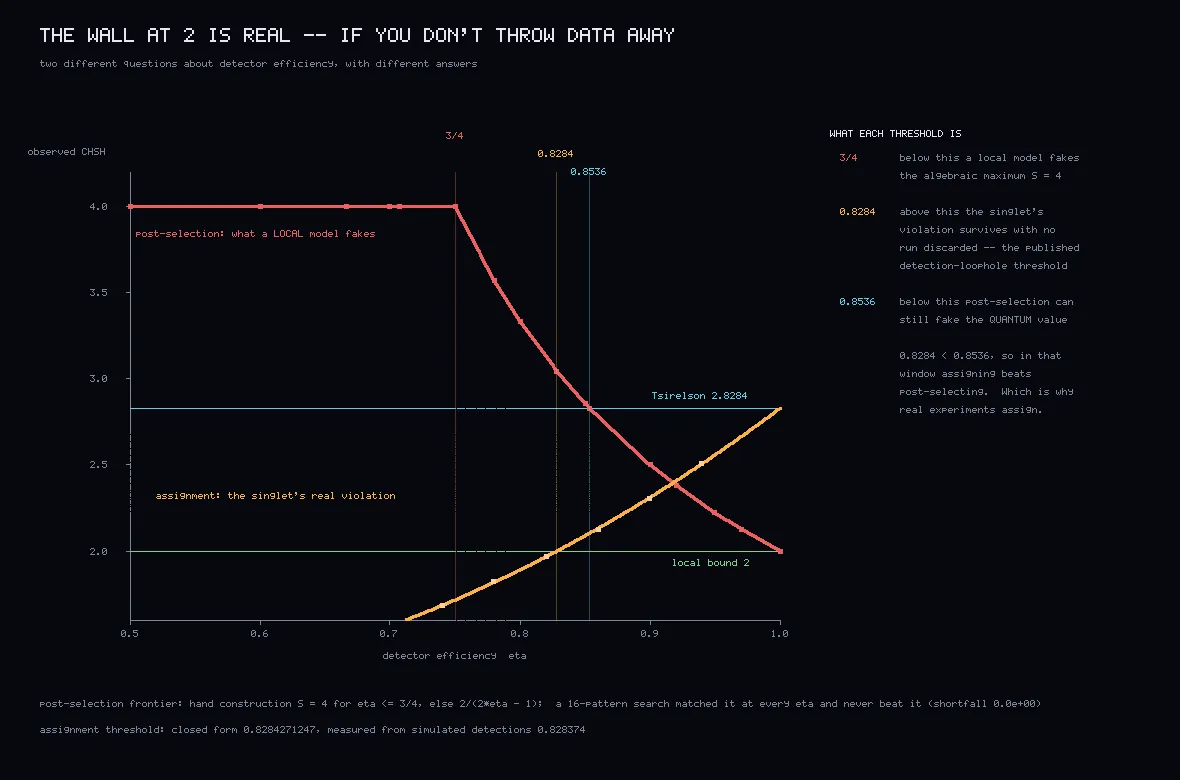
The two thresholds are different numbers. Throwing data away can still fake the quantum value up to 85.36% efficiency, which is above 82.84%. In the window between them, keeping every run gives a real result where throwing runs away would still be fakeable. That is why real experiments keep every run.
What I got wrong
Most of it is above, where it happened: the angles typed from memory, the shared tolerance, and the prediction about faking that came out too low.
The one worth its own paragraph is a mistake I made twice in one night. My first way of finding the crossover asked whether the quantity passed some large number within 400 steps. Those were thresholds I made up, and they put the crossover at 0.707147, wrong in the fifth decimal place. That error was entirely mine, four orders of magnitude larger than the arithmetic underneath. I fixed it by asking about the growth rate instead, which has no made-up patience in it. Then, reproducing the 3.27 threshold later that night, I did the same thing again, iterating 4,000 times and asking whether it moved. That version was a trillion times worse than the derivative test. The second time, I recognised it on sight.
And writing this up, I opened the plates. The label for the bound, the line the whole information chart is about, sat where every curve on the chart starts, and every curve ran through it. The top curve also appeared to level off at the edge of the chart, when it was only being clipped there. Both are fixed in the pictures above.